Author: Derrick Kong

  • The Voyager Probes: Humanity’s Farthest Travelers

    The Voyager Probes: Humanity’s Farthest Travelers

    In the summer of 1977, two spacecraft left Earth within sixteen days of each other. They were built with the computing power of a pocket calculator, designed for a four-year mission to Jupiter and Saturn, and expected to fall silent long before the century ended.

    They are still transmitting.

    The alignment that made it possible

    The Voyager missions exist because of an accident of orbital mechanics. Once every 176 years, the outer planets line up in an arrangement that allows a single spacecraft to visit several of them in sequence, using each planet’s gravity to slingshot on to the next.

    That alignment was available in the late 1970s. Missing it meant waiting nearly two centuries. The gravity-assist technique — stealing a tiny amount of a planet’s orbital momentum to accelerate a spacecraft — made a tour possible that no rocket of the era could have achieved on propulsion alone.

    Voyager 2 launched first, on the slower path that would take it past all four giant planets. Voyager 1 launched second on a faster trajectory, reached Jupiter earlier, and then took a route past Saturn’s moon Titan that flung it up and out of the plane of the solar system.

    What they found

    The scientific return reshaped planetary science, largely because nearly everything was a surprise.

    At Jupiter, the moons turned out to be worlds rather than points of light. Io was found to be volcanically active — the first active volcanism discovered beyond Earth, driven by tidal heating. Europa showed a young, cracked, nearly crater-free ice surface, the first hint of the ocean now thought to lie beneath it. Jupiter turned out to have a faint ring system nobody had predicted.

    At Saturn, the rings resolved into thousands of distinct ringlets with braided and kinked structures that took years to explain. Titan proved to have a thick nitrogen atmosphere, opaque at visible wavelengths, hiding a surface that would not be seen properly for another quarter century.

    Voyager 2 alone continued to Uranus and Neptune, and remains the only spacecraft to have visited either. It found Uranus tipped on its side with a bizarrely offset magnetic field, and at Neptune discovered supersonic winds and a moon, Triton, with active nitrogen geysers erupting from a surface at around 38 kelvin.

    Two spacecraft, one launch window, and the only close-up data humanity has ever collected on two of the eight planets.

    Into interstellar space

    After the planetary encounters, both spacecraft kept going. The mission became a study of the heliosphere — the vast bubble of charged particles blown outward by the Sun.

    Voyager 1 crossed the heliopause, the boundary where the solar wind gives way to the interstellar medium, in 2012. Voyager 2 followed in 2018 on a different trajectory. The crossings were identified not by any dramatic marker but by a sharp change in the density of charged particles and the direction of the magnetic field.

    They are the only spacecraft to have made in-situ measurements of interstellar space, and they found it different from predictions in ways that are still being worked through.

    Keeping them alive

    Both spacecraft are powered by radioisotope thermoelectric generators, which convert heat from decaying plutonium into electricity. The output declines by a few watts every year, and it has been declining for nearly five decades.

    Mission operations has become an exercise in careful triage. Instruments have been switched off one at a time. Heaters have been sacrificed, in some cases leaving components operating well below their rated temperatures — and working anyway. Engineers have swapped to backup thruster sets and rewritten commands for computers whose original programmers have retired.

    The communication challenge is equally severe. Signals take more than twenty hours each way, and arrive with a power measured in fractions of a billionth of a watt, requiring the largest dish antennas on Earth to detect at all.

    Sometime in the 2030s the power budget will fall below what even a single instrument requires, and both spacecraft will go quiet. They will keep travelling regardless, on trajectories that will carry them past other stars in tens of thousands of years.

    The record

    Each Voyager carries a gold-plated copper phonograph record holding sounds and images selected to represent Earth: greetings in dozens of languages, music from many cultures, whale song, thunder, a heartbeat.

    The odds of any of it ever being found are effectively zero, and the people who assembled it knew that. It was never really addressed outward. It is a statement about what a species thought was worth saying about itself, launched at a moment when it had just learned how to leave.
  • Gravitational Waves: Listening to the Universe’s Violent Collisions

    Gravitational Waves: Listening to the Universe’s Violent Collisions

    General relativity has an unusual prediction buried in it: mass in motion should radiate. Not light, but ripples in the geometry of spacetime itself, spreading outward at the speed of light and stretching and squeezing everything they pass through.

    Einstein published the prediction in 1916 and doubted it would ever be observed. He was nearly right — it took a century.

    What a gravitational wave does

    Spacetime is not a passive backdrop. Mass and energy curve it, and changes in that curvature propagate outward as waves.

    When a wave passes, it distorts space perpendicular to its direction of travel, stretching along one axis while compressing along the other, then reversing. A ring of free-floating particles would oscillate into an ellipse and back.

    The effect is real but astonishingly small. A strong gravitational wave from a black hole merger hundreds of millions of light years away changes the length of a four-kilometre baseline on Earth by less than one ten-thousandth the width of a proton. Detecting that is the entire engineering problem.

    How you measure something that small

    The instruments are laser interferometers, and the principle is elegant.

    A laser beam is split and sent down two perpendicular arms, each several kilometres long. Mirrors at the far ends reflect the beams back, and the two are recombined. Under normal conditions the recombined beams cancel out. If a gravitational wave changes the relative length of the arms, even fractionally, the cancellation becomes imperfect and light appears at the detector.

    Making this work against every other source of noise on a geologically active planet required a remarkable set of measures:

    • Mirrors suspended on multi-stage pendulums to isolate them from ground motion.
    • Ultra-high vacuum along the entire beam path, so air currents and refractive index changes do not swamp the signal.
    • Optical cavities that bounce the light back and forth hundreds of times, effectively multiplying the arm length.
    • Quantum noise reduction techniques to push below the limits imposed by the statistics of photon arrival.
    • Multiple detectors on different continents, so that a real astrophysical signal must appear in all of them with the correct light-travel delay.

    That last point is what makes detections credible. A truck passing one facility does not register at another site thousands of kilometres away.

    The first detection and what followed

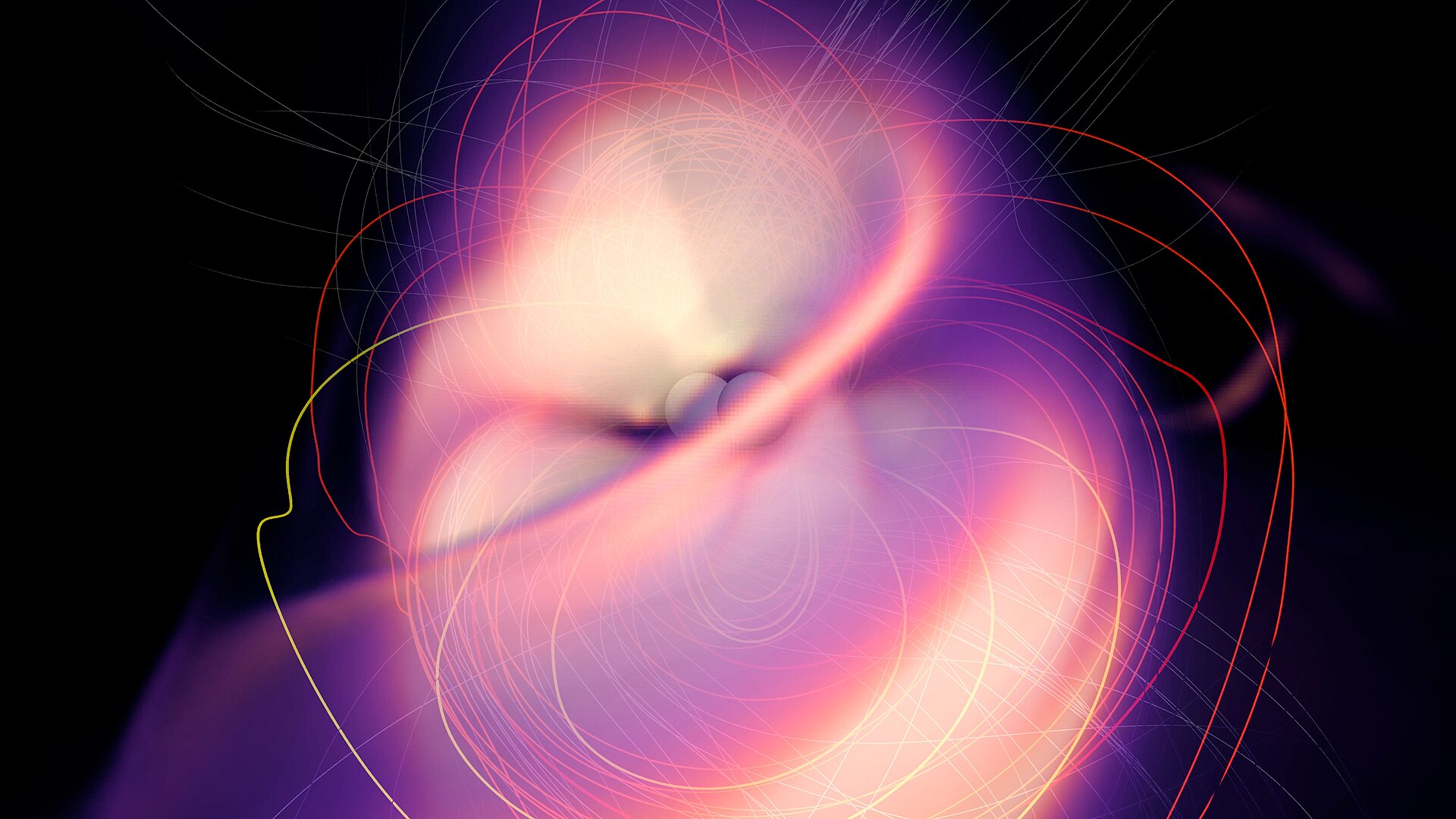
    In September 2015, both detectors of the LIGO observatory recorded a signal lasting a fraction of a second: a rising frequency sweep, ending in a sharp cutoff. It matched the predicted waveform for two black holes of roughly thirty solar masses each spiralling together and merging, more than a billion light years away.

    In the final moments before merging, the pair radiated more power in gravitational waves than all the light from every star in the observable universe combined.

    The announcement in early 2016 confirmed both the existence of gravitational waves and the existence of stellar-mass black hole binaries, neither of which had been directly observed before.

    Detections are now routine, numbering in the hundreds. The population revealed has been informative: black holes heavier than stellar evolution models comfortably predicted, and objects in mass ranges that were expected to be empty.

    The event that opened a new field

    In August 2017, detectors recorded a signal with a different character — longer, and matching two neutron stars rather than black holes. Within seconds, gamma-ray satellites detected a burst from the same region of sky.

    Telescopes across the world and in orbit swung to the location and found the optical counterpart within hours. Over the following days they watched the glow fade and redden in a pattern matching the radioactive decay of freshly synthesised heavy elements.

    That single event confirmed that neutron star mergers produce short gamma-ray bursts, demonstrated that they are a major site for forging elements heavier than iron, provided an independent measurement of the expansion rate of the universe, and constrained the speed of gravitational waves to match the speed of light to within one part in a quadrillion.

    It was the beginning of multi-messenger astronomy — observing the same event through gravity and light simultaneously.

    What is coming

    Ground-based detectors are limited at low frequencies by seismic noise, which caps the mass range they can observe. Supermassive black hole mergers radiate at frequencies far too low to detect from Earth.

    Two approaches address this. Pulsar timing arrays use millisecond pulsars scattered across the galaxy as a natural detector, watching for correlated timing variations caused by very low frequency waves. And a planned space-based interferometer with arms millions of kilometres long would open the band between the two.

    Every time astronomy has gained access to a new part of the spectrum, it has found things nobody predicted. Gravitational waves are not part of the spectrum at all — they are an entirely separate channel.

  • Exoplanets 101: How Astronomers Find Worlds Beyond the Sun

    Exoplanets 101: How Astronomers Find Worlds Beyond the Sun

    The first confirmed planet orbiting a Sun-like star was announced in 1995. It was nothing like what anyone expected: a gas giant roughly half the mass of Jupiter, orbiting its star every four days at a distance far closer than Mercury is to the Sun.

    Thousands of confirmed planets later, the pattern holds. The main lesson of exoplanet astronomy is that our solar system is not the template.

    The problem with looking directly

    Seeing an exoplanet is hard for two reasons that compound each other.

    Planets are faint, shining mostly by reflected light. And they sit extremely close to something overwhelmingly bright. From a distance of tens of light years, an Earth-like planet is roughly ten billion times dimmer than its star and separated by a fraction of an arcsecond.

    Direct imaging works only in favourable cases: young, hot, massive planets still glowing from their formation, orbiting far from their stars, observed with coronagraphs that block the starlight. Most exoplanets are found without ever being seen.

    The two workhorse methods

    Transits

    If a planet’s orbit is aligned so that it passes between us and its star, the star dims slightly. For a Jupiter-sized planet crossing a Sun-like star, the dip is about one percent. For an Earth-sized planet, it is around one hundredth of a percent.

    Measuring that requires exceptional photometric stability, which is why the technique came into its own with dedicated space telescopes staring at the same field for years. The payoff is rich:

    • The depth of the dip gives the planet’s radius relative to the star.
    • The interval between dips gives the orbital period, and therefore the orbital distance.
    • The shape of the dip constrains the orbital geometry.
    • Light filtering through the planet’s atmosphere during transit carries a chemical fingerprint, allowing atmospheric composition to be measured.

    The limitation is geometric. Only a small fraction of planetary systems happen to be edge-on from our vantage point, so transits find a biased sample — but a statistically correctable one.

    Radial velocity

    A planet does not orbit its star. Both orbit their common centre of mass, which means the star traces a small circle in response to the planet’s pull.

    That motion shifts the star’s spectral lines by the Doppler effect — toward the blue as it approaches, toward the red as it recedes. Jupiter makes the Sun wobble at about twelve metres per second. Earth manages roughly nine centimetres per second.

    Detecting shifts that small requires spectrographs of extraordinary stability, calibrated against laser frequency combs and housed in temperature-controlled vacuum chambers. The method gives the orbital period and a minimum mass, since it cannot distinguish a heavy planet in a tilted orbit from a lighter one seen edge-on.

    Combine a transit and a radial velocity measurement and you get both radius and true mass — and therefore density, which tells you whether a planet is rock, ice, or gas.

    The other techniques

    Two further methods fill in parts of the picture the main two miss.

    Gravitational microlensing exploits the chance alignment of a foreground star with a distant background one. The foreground star’s gravity magnifies the background light, and a planet orbiting it adds a brief extra spike. Microlensing is sensitive to planets at wide separations and to free-floating planets bound to no star at all, but events are one-off and cannot be re-observed.

    Astrometry tracks the star’s positional wobble on the sky rather than its velocity along the line of sight, complementing radial velocity for wide orbits.

    What the census shows

    Several findings have reshaped expectations.

    Planets are common. The statistics suggest most stars host at least one, making planets the rule rather than the exception.

    The most abundant planets are of a type absent from our solar system: worlds between Earth and Neptune in size, often called super-Earths or sub-Neptunes. There appear to be two distinct populations separated by a gap in the radius distribution, probably reflecting whether a planet retained or lost a thick hydrogen envelope.

    Hot Jupiters — giant planets in very tight orbits — exist, though they are rarer than early surveys implied, since they are the easiest planets to find and therefore heavily over-represented in raw counts. They almost certainly formed further out and migrated inward.

    Small red dwarf stars, the most common type in the galaxy, frequently host compact multi-planet systems. Because these stars are dim and small, planets in their habitable zones transit more deeply and more often, making them the most accessible targets for atmospheric study.

    The next question

    Cataloguing is giving way to characterisation. The interesting question is no longer how many planets exist but what they are made of, whether they hold atmospheres, and what those atmospheres contain.

    That is a much harder measurement, and the signals are close to the limits of current instruments. But it is the direction the field is now pointed.

  • Saturn’s Rings: What They Are and How Long They Will Last

    Saturn’s Rings: What They Are and How Long They Will Last

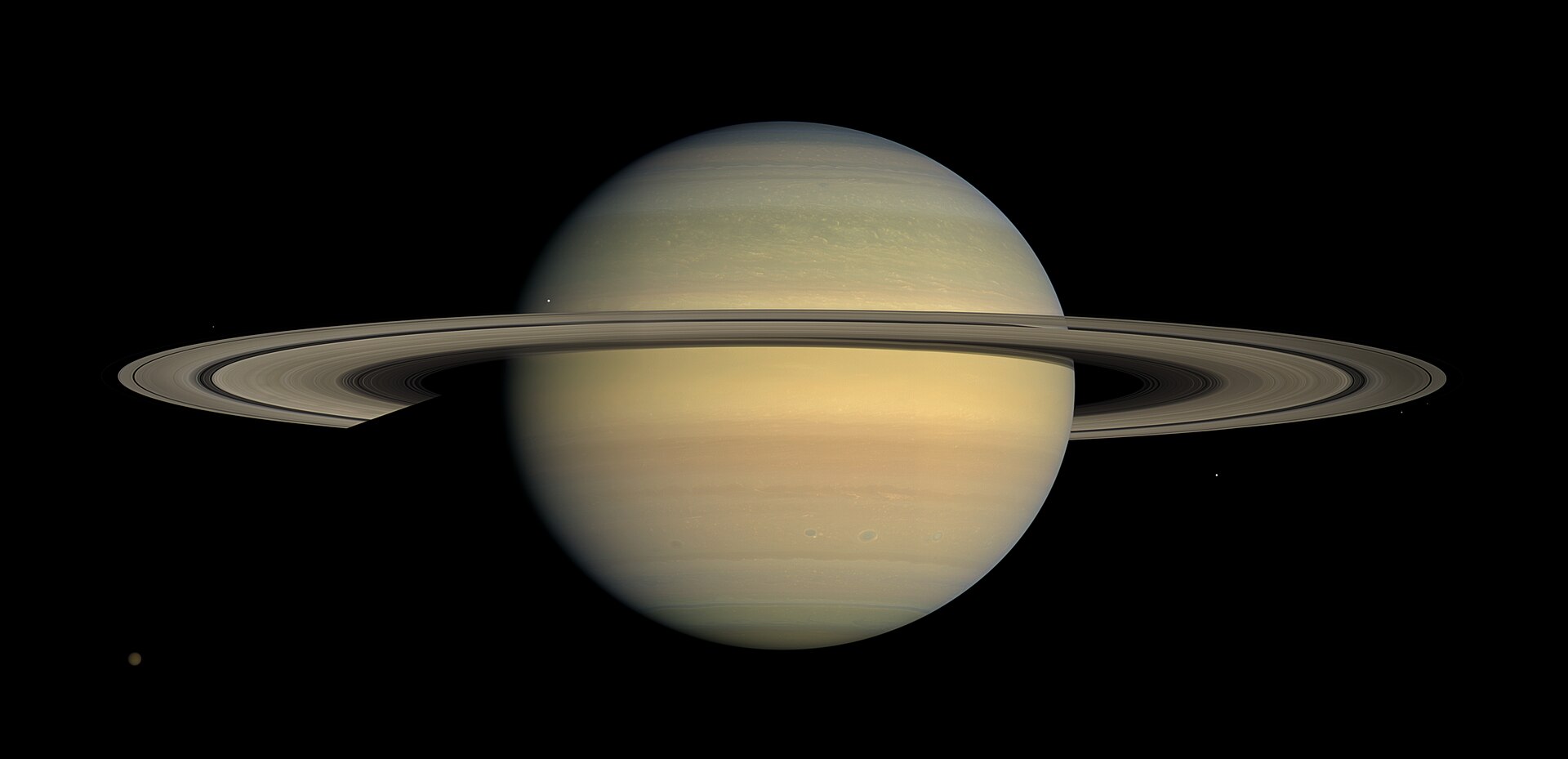
    Saturn is not the only planet with rings. Jupiter, Uranus, and Neptune all have them. What makes Saturn’s exceptional is that they are bright, wide, and visible in a small telescope from a back garden — a planetary feature you can confirm with your own eyes in about ten seconds.

    They are also, on cosmic timescales, probably temporary.

    What they are made of

    The rings are not solid. They are composed of countless individual particles, each on its own orbit around Saturn, ranging from grains of dust to chunks the size of a house.

    The composition is remarkably pure: over ninety percent water ice, with only a small fraction of rocky contamination. That purity is one of the strongest arguments that the rings are young. The solar system is full of micrometeoroid dust, and any ring system exposed to it for billions of years should have accumulated visible darkening. Saturn’s rings are conspicuously clean.

    They are also extraordinarily thin. The main ring system spans roughly 280,000 kilometres across, but its vertical thickness is typically measured in tens of metres. Scaled to the diameter of a sheet of paper, the rings would be thousands of times thinner than the paper itself. This is why they disappear entirely when Earth passes through the ring plane and we view them edge-on.

    Why they are rings and not a moon

    Any material orbiting close to a large planet faces a competition. Its own gravity tries to pull it together into a single body; the planet’s tidal forces try to pull it apart.

    Inside a boundary called the Roche limit, tides win, and material cannot coalesce. Saturn’s main rings lie inside that limit — which is why they remain a disk of separate particles rather than clumping into a moon.

    The structure within the disk comes from moons. Gaps such as the Cassini Division are cleared by orbital resonances with moons further out: particles at certain distances receive a repeated gravitational nudge on every orbit, and are gradually pushed elsewhere. Small shepherd moons orbit within and beside narrow rings, confining their edges. Others create waves and vertical corrugations that propagate across the disk.

    The rings are less a static feature than an ongoing gravitational conversation between Saturn and its moons.

    The age problem

    For most of the twentieth century, the assumption was that the rings formed alongside Saturn roughly four and a half billion years ago. Several lines of evidence now point the other way.

    The purity of the ice, as noted, suggests limited exposure time. More decisively, measurements made during a spacecraft’s final orbits between the planet and the innermost ring allowed the total mass of the ring system to be determined directly for the first time — and it turned out to be relatively low, roughly comparable to one of Saturn’s mid-sized icy moons.

    A low-mass ring system is easier to erode and harder to sustain. Combined with the estimated rate at which material is contaminated and lost, the numbers point toward an age in the range of tens to a few hundred million years. That would mean the rings formed while dinosaurs walked on Earth, and that for most of Saturn’s history it looked considerably less impressive.

    The obvious follow-up question — what happened a hundred million years ago to create them — does not have a settled answer. A moon that wandered inside the Roche limit and was torn apart is the leading category of explanation.

    Ring rain

    The rings are also disappearing, and the mechanism has been measured.

    Ice particles in the rings become charged, either by ultraviolet sunlight or by plasma in Saturn’s magnetosphere. Once charged, they are captured by the planet’s magnetic field and channelled down into the upper atmosphere, where they fall as a steady drizzle of water.

    Measurements of this ring rain suggest losses substantial enough to drain the rings entirely within roughly a hundred million years — possibly considerably less. The number carries real uncertainty, and estimates have shifted as the data improved, but the direction is not in dispute.

    A matter of timing

    The combination is striking. If the rings are only a hundred million years old and have another hundred million years left, then the entire span during which Saturn possesses spectacular rings is a narrow window in a four-and-a-half-billion-year history — and we happen to be alive inside it.

    That is not evidence of anything cosmically special about the present moment. It is a reminder that the solar system is not a finished, static arrangement. It is a system still in motion, and some of its most familiar features are passing phases we caught mid-sentence.

  • Light Pollution and How to Find Truly Dark Skies

    Light Pollution and How to Find Truly Dark Skies

    For most of human history, the Milky Way was an unremarkable fact of life — a band of light overhead that every culture built stories around. It is now invisible to the majority of people on Earth. Roughly a third of humanity, and around eighty percent of people in North America and Europe, live under skies too bright to see it at all.

    The cause is not pollution in the usual sense. It is light that was generated deliberately and then aimed, scattered, or wasted where nobody needed it.

    What light pollution actually is

    The term covers several distinct problems, and they are worth separating because they have different fixes.

    • Skyglow is the diffuse orange or grey dome over populated areas, caused by artificial light scattering off molecules and aerosols in the atmosphere. This is what erases the stars.
    • Glare is excessive brightness that reduces contrast and impairs vision, often making a scene less visible rather than more.
    • Light trespass is light falling where it is not wanted — a neighbour’s floodlight through a bedroom window.
    • Clutter is the confusing excess of bright, competing sources common in commercial areas.

    Skyglow travels. A city can noticeably brighten the sky a hundred kilometres away, which is why genuinely dark sites are increasingly hard to reach from most population centres.

    How it is measured

    Astronomers use the Bortle scale, a nine-point classification running from Class 1 — an exceptionally dark site where the Milky Way casts visible shadows and the zodiacal light is obvious — to Class 9, an inner-city sky where only the Moon, planets, and a handful of the brightest stars are visible.

    A useful rule of thumb is the number of stars visible to the naked eye. Under a truly dark sky, that number is a few thousand. In a suburban sky it may be a few hundred. In a city centre it can drop into the dozens.

    Another practical test is whether the Milky Way is visible at all. If it is not, you are already losing most of what the sky has to offer.

    Under a Class 1 sky, the Milky Way is bright enough to be mistaken for cloud. Most people have never seen this.

    It is not only an astronomy problem

    The case against light pollution does not rest on stargazing alone.

    Nocturnal animals — which is most animal species — evolved under natural light cycles, and artificial light disrupts them measurably. Migrating birds are drawn off course by illuminated buildings, sometimes fatally. Sea turtle hatchlings navigate toward the brightest horizon, which used to be the ocean and is now often a car park. Insect populations are drawn to lights and die there in numbers that matter for pollination and food webs.

    Human circadian rhythms respond to light exposure, particularly at the blue end of the spectrum, and there is a substantial body of research on the effects of nighttime light on sleep.

    And there is the straightforward economic point: light directed upward into the sky is energy paid for and thrown away.

    The LED complication

    The transition to LED street lighting was, on paper, an environmental improvement — dramatically more efficient, longer-lived, and easier to control.

    In practice the early rollouts often made skyglow worse. Two reasons: many first-generation installations used high colour temperatures rich in blue light, which scatters far more efficiently in the atmosphere than warmer wavelengths. And because LEDs are cheap to run, the efficiency gains were frequently spent on more light rather than lower bills — a rebound effect familiar from other efficiency transitions.

    The fix is well understood. Warmer colour temperatures, full-cutoff fixtures that direct light downward, dimming or switching off during hours of low use, and lighting levels matched to actual need. LEDs are more controllable than what they replaced; the technology was never the problem.

    Finding a dark sky

    The practical question for an observer is where to go.

    Light pollution atlases are freely available online and show skyglow mapped globally, which is the fastest way to identify promising directions from where you live. Certified dark-sky places — parks, reserves, and communities that have adopted lighting standards — are a good starting point and are usually set up for visitors.

    A few practical notes. Elevation helps, since getting above haze and low-level moisture improves transparency considerably. Distance from a city matters more than absolute remoteness, and direction matters too: a site fifty kilometres from a city has a bright horizon in one direction and a dark one in the other, so plan what you want to observe accordingly.

    Time it near new Moon, check that the site is legally accessible after dark, and tell someone where you are going.

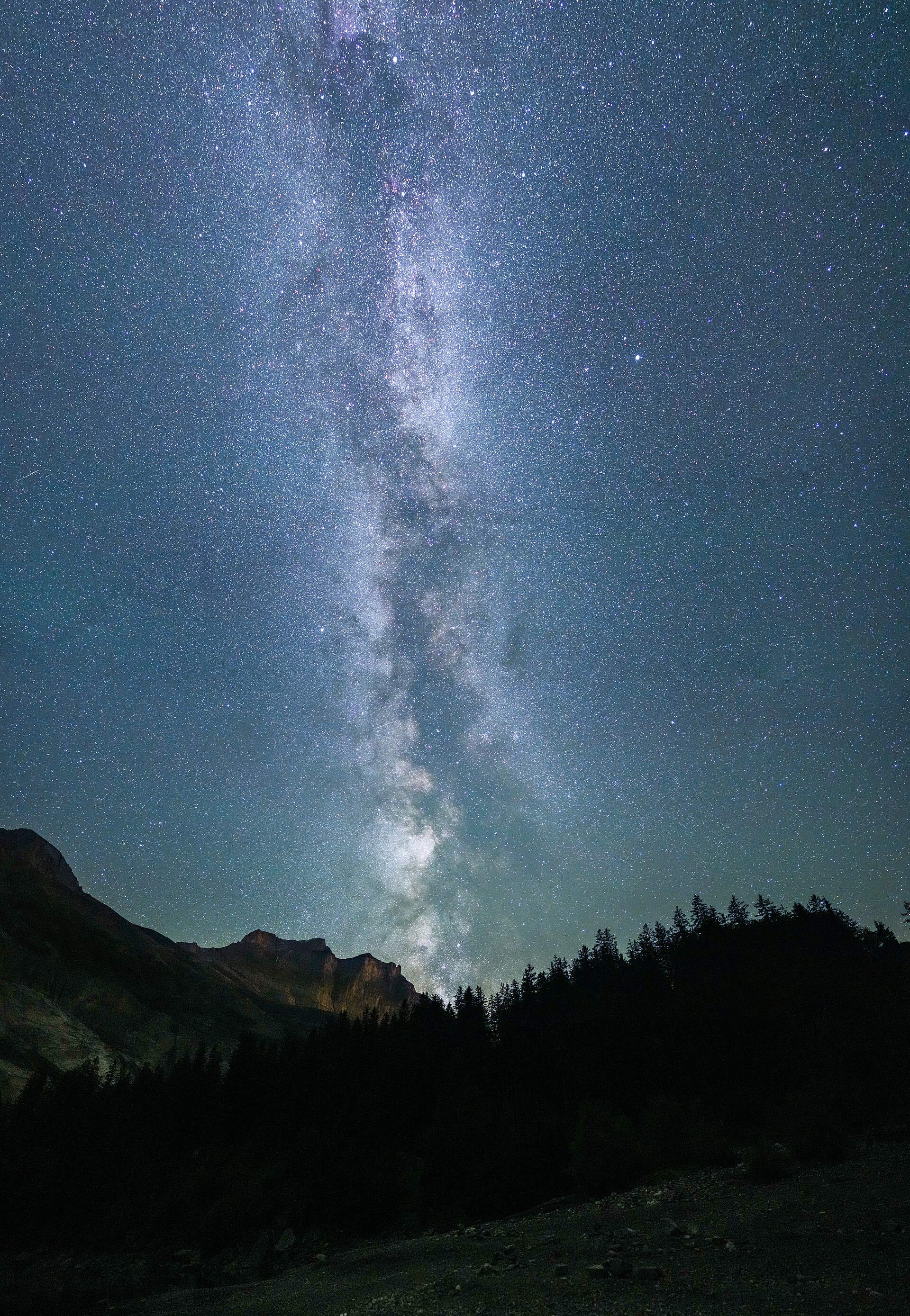
    The first time you see the Milky Way properly is memorable in a way that is hard to convey secondhand. It is not a faint smudge. It has structure, dust lanes, and enough brightness to be startling.

  • The Big Bang: What We Know About the Universe’s First Moments

    The Big Bang: What We Know About the Universe’s First Moments

    The Big Bang is routinely misdescribed, including by people who should know better. It was not an explosion in space. There was no centre, no bang, and nothing sitting in a void waiting to detonate.

    What the theory actually says is more modest and better supported: the universe was once hot, dense, and nearly uniform, and it has been expanding and cooling ever since. Everything else follows from that.

    The evidence

    Three independent observations underpin the model, and they were not designed to fit together.

    Everything is receding

    Distant galaxies show redshifted light, and the redshift increases with distance. Run that expansion backwards and the material of the universe converges toward arbitrarily high density at a finite time in the past — currently placed at about 13.8 billion years ago.

    The universe is glowing faintly at microwave wavelengths

    For its first few hundred thousand years, the universe was an opaque plasma. Photons scattered constantly off free electrons and could not travel far. As expansion cooled the plasma below roughly 3,000 kelvin, electrons and nuclei combined into neutral atoms, and the universe abruptly became transparent.

    The light released at that moment has been travelling ever since, stretched by expansion into the microwave band. It arrives from every direction at a temperature of about 2.7 kelvin. This cosmic microwave background was predicted before it was found, and its discovery in 1965 effectively settled the argument between the Big Bang model and its steady-state rival.

    The lightest elements are in the right proportions

    In the first few minutes, the universe was hot enough for nuclear fusion but expanding too fast for it to continue long. The model predicts specific abundances of hydrogen, helium, and traces of lithium and deuterium emerging from that brief window.

    The predicted values — roughly seventy-five percent hydrogen and twenty-five percent helium by mass — match what is measured in the oldest, least processed material astronomers can find. That agreement spans several elements across many orders of magnitude in abundance, from a calculation with essentially one free parameter.

    A theory that predicts the temperature of the sky and the chemical composition of the universe from the same set of equations is doing real work.

    The timeline

    The sequence, compressed:

    • In the first fraction of a second, the universe is thought to have undergone inflation — an episode of extraordinarily rapid expansion that flattened its geometry and stretched quantum fluctuations into the seeds of all later structure.
    • Within the first second, the fundamental forces took their present distinct forms and quarks condensed into protons and neutrons.
    • Over the first few minutes, nuclear fusion produced the light elements.
    • For 380,000 years, the universe remained an opaque plasma.
    • At 380,000 years, atoms formed and the microwave background was released.
    • A long dark period followed, during which gravity slowly amplified the small density variations left over from inflation.
    • Somewhere in the first few hundred million years, the first stars ignited, and galaxies began assembling.

    The parts we cannot see

    Note where the account starts. The model describes the universe from a tiny fraction of a second onward, not from a moment of creation.

    Earlier than that, densities and temperatures exceed anything current physics can describe. General relativity predicts a singularity, but that prediction is generally taken as the theory announcing its own breakdown rather than a statement about reality. Describing the first instant requires a theory unifying quantum mechanics and gravity, which does not yet exist.

    So “what came before the Big Bang” is not a question the theory refuses to answer out of stubbornness. It is a question that requires physics we do not have.

    What inflation explains, and what it does not

    Inflation was proposed to solve specific puzzles. Why is the universe geometrically flat to high precision? Why do regions on opposite sides of the sky, which have never been in causal contact, have almost exactly the same temperature? Why do we not observe the exotic relics that some particle theories predict?

    Rapid early expansion answers all three: it flattens curvature, it means the whole observable universe was once a tiny causally connected patch, and it dilutes any relics to undetectable levels.

    Inflation also makes a prediction that has been tested — that quantum fluctuations stretched to cosmic scales should leave a specific statistical pattern in the microwave background. The observed pattern matches well.

    What remains unsettled is the mechanism. Inflation is a framework rather than a single theory, with many possible implementations and no consensus on which is right, and no direct evidence yet for the primordial gravitational waves that many versions predict.

    Where it stands

    The hot Big Bang model is among the best-tested theories in science, describing the universe’s history from the first second to the present with quantitative precision.

    It is also unmistakably incomplete. It requires dark matter and dark energy, neither of which is understood. It cannot describe its own initial conditions. And there is a live disagreement about the current expansion rate that has resisted a decade of scrutiny.

    That combination — enormously successful and visibly unfinished — is roughly where a healthy scientific field should be.

  • Life Aboard the International Space Station

    Life Aboard the International Space Station

    The International Space Station has been continuously inhabited since November 2000. Somebody has been off the planet every day for a quarter of a century.

    It is roughly the size of a football field, circles Earth about every ninety minutes, and travels at around 28,000 kilometres per hour. From the inside, none of that is what defines the experience. What defines it is that nothing stays where you put it.

    Freefall, not zero gravity

    The station is not beyond Earth’s gravity. At its altitude of roughly 400 kilometres, gravity is still about ninety percent as strong as at the surface.

    What produces weightlessness is that the station and everything inside it are falling continuously, and moving sideways fast enough that the ground curves away beneath them at the same rate. Orbit is not the absence of falling. It is falling and missing.

    The correct term is microgravity, since small residual accelerations remain from atmospheric drag, equipment vibration, and crew movement. For sensitive experiments, those tiny forces matter.

    What the body does about it

    Human physiology assumes a downward direction, and removing it triggers a cascade of adaptations.

    Fluids that gravity normally pools in the legs shift upward, producing puffy faces and congestion for the first days. Bones lose density at a rate comparable to advanced osteoporosis, concentrated in the load-bearing structures that no longer bear load. Muscles atrophy, particularly in the legs and back.

    The countermeasure is exercise, treated as a non-negotiable part of the schedule: around two hours a day on a treadmill with a harness to hold the runner down, a stationary cycle, and a resistance device that simulates weightlifting using vacuum cylinders.

    Vision changes have emerged as one of the more concerning long-duration effects, apparently related to pressure changes from the fluid shift, and some cases have not fully reversed after return. Radiation exposure is elevated, since the station sits above most of the atmosphere though still within the protection of Earth’s magnetic field.

    Astronauts return measurably taller, having lost the spinal compression that gravity imposes all day on the ground. It does not last.

    Ordinary tasks, redesigned

    Every routine activity had to be reconsidered.

    • Sleeping happens in a padded booth roughly the size of a phone box, in a sleeping bag attached to the wall. Orientation is irrelevant; there is no down.
    • Eating works because surface tension holds liquids in place. Most food is rehydrated or thermostabilised, eaten from packages, and seasoning is supplied as liquid so it does not drift into equipment.
    • Washing is done with rinseless soap and towels. There is no shower, since water would not drain.
    • The toilet uses airflow instead of gravity, with separate systems for solid and liquid waste. Urine is recovered and processed back into drinking water, which recycles a large fraction of the station’s supply.
    • Sixteen sunrises and sunsets per day make natural light cues useless, so the crew works on coordinated universal time with a carefully managed schedule.

    Where the time goes

    A typical day runs roughly twelve hours, with science and maintenance dominating.

    The station’s purpose is to be a laboratory, and the research spans protein crystal growth in the absence of convection, combustion physics without buoyancy, materials science, plant biology, and long-term studies of the human body itself. Much of it is work that cannot be done on the ground because gravity interferes.

    Maintenance is a larger share than most people assume. The station is an ageing spacecraft with life support, thermal control, power, and communication systems that require constant attention. Filters get cleaned. Pumps get replaced. Occasionally something breaks that requires a spacewalk, which involves hours of preparation, a suit that functions as a personal spacecraft, and a task list rehearsed extensively in a pool on Earth.

    The cooperative part

    The station is assembled from modules built by multiple space agencies and operated jointly by the United States, Russia, Europe, Japan, and Canada. Segments are structurally and functionally interdependent — power, propulsion, and life support are shared across national boundaries by design.

    It has continued operating through periods of considerable political friction on the ground, which is either a testament to the durability of technical cooperation or simply a consequence of the fact that the modules cannot be separated. Probably both.

    The end of the programme

    The station has a finite life. Structural fatigue accumulates, and hardware designed decades ago becomes progressively harder to support. Current planning points toward retirement around the end of this decade, with a controlled deorbit over the remote Pacific.

    Several commercial stations are in development to succeed it. Whether the handover is seamless is an open question — but the goal is that the streak of continuous human presence in orbit, now well past twenty-five years, does not break.

  • The Search for Life: Inside Astrobiology’s Biggest Questions

    The Search for Life: Inside Astrobiology’s Biggest Questions

    Astrobiology has an awkward founding problem: it is a scientific field studying a subject with no confirmed examples beyond a single case. Every organism ever examined descends from a common ancestor on one planet.

    That does not make the field unserious. It makes it unusually careful about definitions.

    The questions underneath the question

    “Are we alone” decomposes into several distinct problems, and conflating them causes most of the confusion in public discussion.

    • How does non-living chemistry become living chemistry? This is the origin-of-life problem, and it is a question about Earth as much as anywhere else.
    • Given a habitable environment, how likely is life to arise? Unknown, and the single data point we have does not constrain it.
    • Given microbial life, how likely is complex multicellular life? On Earth this took billions of years, which may or may not mean it is difficult.
    • Given complex life, how likely is technology? An entirely separate question, and the one SETI addresses.

    Confirming microbial life on Mars would be one of the most significant discoveries in history and would say almost nothing about the fourth question.

    What counts as habitable

    The working definition centres on liquid water, an energy source, and the elements life needs — carbon, hydrogen, nitrogen, oxygen, phosphorus, sulphur.

    Liquid water gets the emphasis because it is an unusually good solvent, remains liquid across a wide temperature range, and participates directly in biochemistry. This may be parochial, but it is the only chemistry with a demonstrated track record.

    The classical habitable zone is the orbital band around a star where a planet with an Earth-like atmosphere could sustain surface liquid water. It is a useful screening tool and a poor final criterion, because it ignores atmospheric composition, and because it says nothing about subsurface oceans.

    That last point has reshaped the field. Europa, Enceladus, Titan, Ganymede, and possibly others hold liquid water far outside any star’s habitable zone, kept warm by tidal heating rather than sunlight. If subsurface oceans are the most common habitable environment in the universe, then habitable-zone statistics are measuring the wrong thing.

    What Earth’s extremophiles taught us

    The expansion of the habitability concept came largely from discovering how much of Earth is inhabited.

    Microbes thrive in near-boiling hydrothermal vents, in brine at temperatures well below freezing, in highly acidic mine drainage, under crushing pressure in ocean trenches, in rock kilometres below the surface, and in radiation fields that would sterilise most laboratory equipment.

    Deep-sea vent ecosystems were particularly consequential because they run on chemical energy rather than sunlight. Before their discovery, photosynthesis seemed a near-prerequisite for a substantial biosphere. It is not.

    Every time the known limits of life on Earth were tested, they turned out to be wider than assumed.

    How you would actually detect it

    Three broad strategies are in play, with different timescales and different failure modes.

    Look for it in the solar system

    Send instruments to Mars, to the plumes of Enceladus, to Europa, to Titan. The advantage is direct access to material. The difficulty is that detecting life is genuinely hard even with a sample in hand — distinguishing biological signatures from abiotic chemistry has tripped up serious researchers before, including in the ambiguous results of the Viking landers in the 1970s.

    Planetary protection is a real constraint here. Spacecraft are sterilised to avoid the outcome where the life detected turns out to have arrived on the probe.

    Look for atmospheric biosignatures

    An atmosphere far from chemical equilibrium suggests something is continuously replenishing it. Earth’s simultaneous oxygen and methane would be difficult to explain without biology.

    Transit spectroscopy can now measure exoplanet atmospheric composition, though for small rocky planets the signals sit at the edge of what current instruments can achieve. The interpretive problem is severe: for nearly every proposed biosignature, someone has since identified an abiotic pathway that could produce it.

    Look for technology

    SETI searches for signals — narrowband radio transmissions, optical pulses — that no natural process is known to produce. It is inexpensive relative to spacecraft and can cover enormous volumes of space, but it assumes a technological civilisation transmitting detectably during the window we happen to be listening.

    The uncomfortable silence

    The Fermi paradox is the observation that the galaxy is old, contains hundreds of billions of stars, and shows no obvious sign of anyone. Proposed resolutions range from life being rare, to intelligence being rare, to civilisations being short-lived, to our searches having covered a negligible fraction of the relevant parameter space.

    The last explanation is the most defensible and the least satisfying. The volume of signal types, frequencies, and directions searched so far is small compared to the space of possibilities.

    Astrobiology’s honest position is that we do not know, that the question is now approachable with real instruments rather than speculation alone, and that the most likely first discovery is microbial, ambiguous, and argued over for a decade.

  • The Speed of Light and Why Nothing Can Go Faster

    The Speed of Light and Why Nothing Can Go Faster

    Light travels at 299,792,458 metres per second in a vacuum. That figure is not measured any more — it is defined. In 1983 the metre was redefined as the distance light travels in a specific fraction of a second, which means the speed of light is now exact by construction.

    That administrative detail hints at something deeper. The speed of light is not really a fact about light. It is a fact about the structure of spacetime, and light just happens to travel at it.

    The constant that broke classical physics

    Nineteenth-century physics assumed velocities add. Throw a ball forward from a moving train and its speed relative to the ground is the ball’s speed plus the train’s.

    Maxwell’s equations, which unified electricity and magnetism, predicted electromagnetic waves travelling at a specific speed — and conspicuously did not specify relative to what. The assumed answer was a medium called the luminiferous aether, filling all space, with the speed of light measured relative to it.

    Experiments designed to detect Earth’s motion through this aether found nothing. Repeatedly, at increasing precision, in every orientation and season. Light’s measured speed came out the same regardless of how the observer was moving.

    Einstein’s move in 1905 was to stop treating this as a puzzle to be explained away and instead adopt it as a starting assumption. If the speed of light is the same for all observers, then the things that must give are space and time themselves.

    What follows

    The consequences are counterintuitive but have been confirmed to extraordinary precision.

    • Moving clocks run slow relative to a stationary observer. This is not a measurement artefact; it is a property of time. GPS satellites must correct for it or navigation errors accumulate at kilometres per day.
    • Moving objects contract along their direction of motion.
    • Simultaneity is relative. Two events that are simultaneous for one observer are not simultaneous for another moving relative to the first. There is no universal “now.”
    • Mass and energy are equivalent, related by the most famous equation in physics.

    None of this is noticeable at everyday speeds, because the effects scale with the ratio of velocity to the speed of light, and that ratio is negligible for anything humans routinely experience.

    Why nothing can catch up

    The barrier is not a matter of insufficient engineering. It is built into the mathematics.

    As an object with mass accelerates, its kinetic energy grows — but not in the classical proportion. Approaching light speed, the energy required for each additional increment of velocity increases without bound. Reaching the speed of light exactly would require infinite energy.

    Particle accelerators demonstrate this daily. Protons in the largest machines reach well over 99.99 percent of light speed, and enormous additional energy input moves them a vanishingly small fraction closer. They never arrive.

    Massless particles are the mirror image: they have no choice but to travel at exactly that speed, and cannot be slowed or brought to rest.

    The speed of light is better understood as the speed of causality — the maximum rate at which any influence can propagate.

    Causality is what is really being protected

    The deepest reason for the limit is not about energy budgets. It is about cause and effect.

    Because simultaneity is relative, an influence travelling faster than light between two events would, for some observers, arrive before it departed. Effects would precede causes, and not merely in appearance — different observers would disagree about which event caused which.

    The speed limit is what keeps the causal order of the universe consistent for everyone. This is why physicists treat proposed faster-than-light mechanisms with such suspicion: the problem is rarely energy, it is that a working one would function as a time machine, with all the associated paradoxes.

    The apparent exceptions

    Several phenomena are described as exceeding light speed, and each dissolves under examination.

    Light slows in a medium — to around two-thirds of its vacuum speed in glass — and particles can travel through that medium faster than light does locally. This produces Cherenkov radiation, the blue glow in nuclear reactor pools. Nothing exceeds the vacuum speed.

    The expansion of the universe causes sufficiently distant galaxies to recede faster than light. This is expansion of space itself rather than motion through space, and no information is transmitted.

    Quantum entanglement produces correlated measurement outcomes between separated particles, but the outcomes are individually random. No signal can be sent, and the correlations only become apparent when the results are compared through an ordinary channel — limited, as always, by light speed.

    A spotlight swept across a distant surface can move its illuminated spot faster than light. The spot is not an object and carries no information from one point to the next.

    What it means practically

    The limit sets the scale of everything. The Sun is eight light-minutes away. The nearest star system is four light years. Commands to spacecraft in the outer solar system take hours each way, which is why they must operate with substantial autonomy.

    For interstellar travel, the limit is absolute in a way engineering cannot negotiate around. Any journey to another star takes years at minimum, measured in the reference frame of the people waiting at home.

  • Auroras Explained: The Science Behind the Northern and Southern Lights

    Auroras Explained: The Science Behind the Northern and Southern Lights

    An aurora is the visible end of a chain that starts on the Sun, crosses a hundred and fifty million kilometres of space, is caught and redirected by Earth’s magnetic field, and finishes with individual atoms in the upper atmosphere emitting specific wavelengths of light.

    The whole system is a demonstration that the space between the Sun and Earth is not empty.

    The chain, step by step

    The Sun leaks

    The Sun’s outer atmosphere is hot enough that its plasma is not gravitationally bound. It streams outward continuously as the solar wind — a thin flow of protons and electrons moving at hundreds of kilometres per second, permeating the entire solar system.

    The Sun also produces episodic events: coronal mass ejections, which are enormous eruptions of magnetised plasma. These are what drive the strongest auroral displays, and their arrival is what space weather forecasters watch for.

    Earth deflects most of it

    Earth generates a magnetic field in its liquid iron outer core. That field carves out a cavity in the solar wind — the magnetosphere — which deflects the majority of incoming particles around the planet, compressed on the sunward side and drawn into a long tail behind.

    This shielding is not incidental. It is one of the reasons Earth retained its atmosphere while Mars, which lost its global magnetic field early, did not.

    Some particles get in anyway

    The magnetosphere is not sealed. When the solar wind’s magnetic field is oriented opposite to Earth’s, the two can reconnect, opening pathways for particles to enter and be stored in the magnetotail.

    Reconnection events in the tail then accelerate those particles back along field lines toward Earth. Because magnetic field lines converge at the poles, the particles are funnelled into two rings around the magnetic poles — the auroral ovals.

    Atoms light up

    At altitudes between roughly 100 and 400 kilometres, the incoming electrons collide with atmospheric atoms and molecules, kicking their electrons into higher energy states. When those electrons drop back down, they emit photons at wavelengths determined entirely by the atom involved.

    • Green, the dominant colour, comes from atomic oxygen at around 100 to 250 kilometres.
    • Red comes from atomic oxygen higher up, above roughly 250 kilometres, where collisions are rare enough to allow a slow transition to complete.
    • Blue and purple come from ionised nitrogen, usually at lower altitudes and typically visible only in stronger displays.

    The colours are not a lighting effect. They are the emission spectra of specific atoms, read directly off the sky.

    Why the shapes move

    Auroras are rarely static. They form arcs, curtains, rays, and occasionally fill the whole sky in a rapid brightening called a substorm.

    The vertical striping in curtains traces magnetic field lines — the particles are following them down, so the visible structure maps the field’s geometry. The rapid motion during substorms reflects the sudden release of energy stored in the stretched magnetotail.

    The two hemispheres light up more or less simultaneously and often in near-mirror-image patterns, since the same field lines connect north and south. The southern lights are less frequently observed simply because there is less land under the southern auroral oval.

    Seeing them

    Auroras are best hunted with a few practical rules.

    Location matters most. The auroral oval typically sits over northern Scandinavia, Iceland, northern Canada, Alaska, and Siberia. During strong geomagnetic storms it expands toward the equator, occasionally reaching mid-latitudes — which is when auroras make the news.

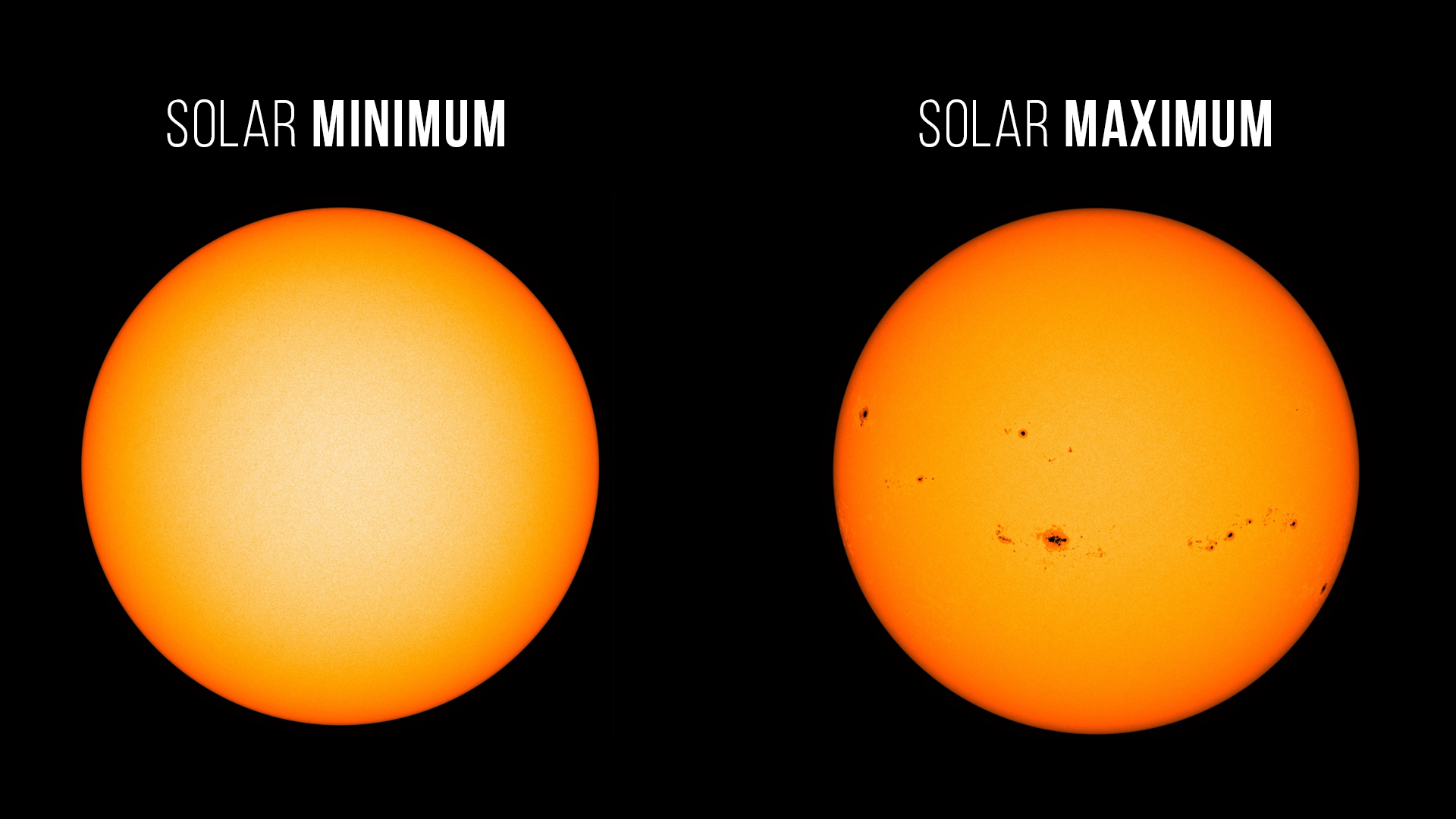
    Timing follows the solar cycle. Solar activity rises and falls over roughly eleven years, and displays are more frequent and more intense near solar maximum. Within a night, the hours around local magnetic midnight tend to be most active.

    Dark and clear are prerequisites. Aurora hunting has the same enemies as any night-sky activity: cloud, moonlight, and streetlights.

    Forecasts are genuinely useful. The Kp index gives a rough measure of geomagnetic disturbance on a scale of zero to nine, and satellites at the L1 point upstream of Earth provide roughly thirty to sixty minutes of warning as the solar wind arrives.

    One expectation to adjust: cameras are more sensitive to faint aurora than the eye is, particularly to red. A display that photographs vividly may look pale grey-green in person. That is not a failure of the aurora; it is a property of human night vision, which is poor at colour.

    The part that is not decorative

    The same solar events that cause auroras can induce currents in long conductors on the ground — power grids, pipelines, undersea cables. Severe geomagnetic storms have caused regional blackouts and have damaged transformers.

    They also degrade radio communication, disrupt satellite navigation, increase drag on spacecraft in low orbits, and pose a radiation risk to astronauts and to passengers on polar flight routes.

    Aurora forecasting exists mainly for that reason. The lights are the visible symptom of a system that industrial infrastructure has become quite sensitive to.

  • Comets and Asteroids: The Solar System’s Time Capsules

    Comets and Asteroids: The Solar System’s Time Capsules

    The planets are the solar system’s finished products, reprocessed by heat, pressure, and four and a half billion years of geology. Comets and asteroids are the offcuts — leftover material that never assembled into anything larger, and which in many cases has barely changed since.

    That makes them the closest thing available to a physical record of what the solar system was made of before the planets rearranged everything.

    The basic distinction

    The traditional split is compositional and reflects where each population formed.

    Asteroids are rocky and metallic, and formed inside the frost line — the distance from the young Sun beyond which water ice could remain solid. Most orbit in the main belt between Mars and Jupiter.

    Comets are ice-rich mixtures of water ice, frozen carbon dioxide, carbon monoxide, ammonia, methane, dust, and organic compounds. They formed further out where those ices were stable, and they reside in two distant reservoirs: the Kuiper Belt beyond Neptune, and the Oort Cloud, a roughly spherical shell extending an appreciable fraction of the way to the nearest stars.

    The line has blurred with better observation. Some asteroids show comet-like activity; some comets appear largely depleted of volatiles. The populations grade into each other.

    Why comets grow tails

    A comet spends most of its orbit as an inert nucleus, typically a few kilometres across and among the darkest material in the solar system.

    Approaching the Sun, its surface ices sublimate directly from solid to gas. The escaping gas carries dust with it, forming a coma — a diffuse atmosphere that can swell to hundreds of thousands of kilometres across, far larger than the nucleus itself.

    Two distinct tails then develop, and they point in different directions.

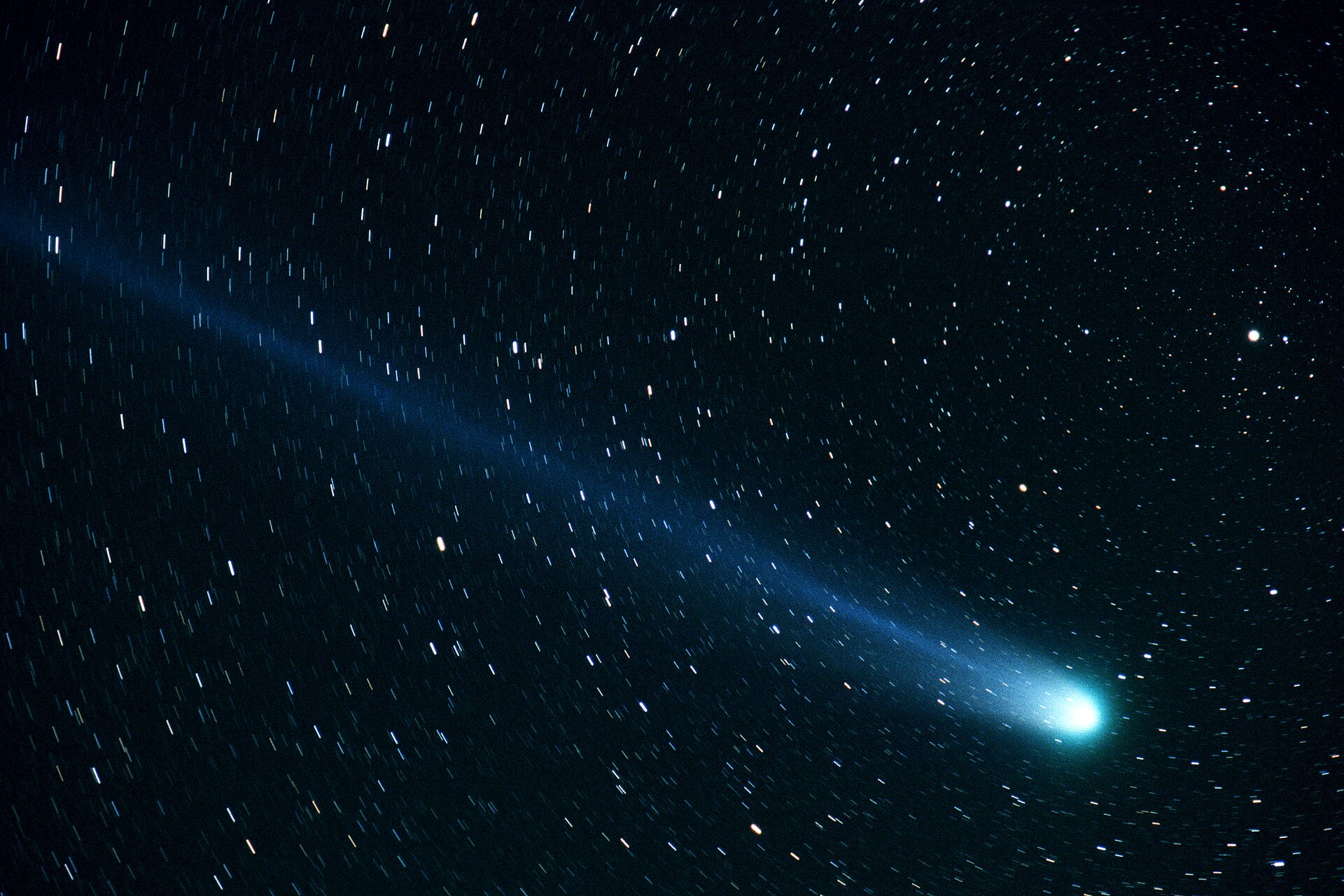
    • The dust tail is pushed outward by radiation pressure. Because the released dust retains some of the comet’s orbital motion, this tail is broad and curved, often appearing yellowish-white from reflected sunlight.
    • The ion tail is formed of gas ionised by solar ultraviolet and swept directly away by the solar wind. It points almost exactly anti-sunward regardless of the comet’s direction of travel, and glows blue from carbon monoxide ions.

    A comet’s tail therefore does not trail behind it. On the outbound leg of the orbit, the comet is chasing its own tail.

    The nucleus of a comet is typically darker than charcoal. Everything spectacular about a comet is material it is losing.

    Why the main belt never became a planet

    The asteroid belt is often described as a shattered planet. It is not. The total mass of everything in it is only a small fraction of the Moon’s.

    The belt failed to accrete because Jupiter formed nearby and early. Its gravity stirred the region, raising relative velocities to the point where collisions between planetesimals became destructive rather than constructive. Bodies that met at a few metres per second stick together; bodies that meet at five kilometres per second shatter.

    Orbital resonances with Jupiter also carved gaps in the belt — the Kirkwood gaps — where repeated gravitational nudges destabilise orbits over time. It is partly through those resonances that fragments get delivered to the inner solar system as meteorites.

    What they have told us

    Meteorites — asteroid fragments that survive to the ground — are the oldest solids anyone has ever handled. Radiometric dating of inclusions within primitive meteorites gives an age of about 4.567 billion years, and that measurement is the basis for the accepted age of the solar system.

    Comets have been visited by spacecraft, including one mission that orbited a comet for two years and watched its activity rise and fall through perihelion. Sample return missions have brought material back from asteroids, and analysis has found amino acids, sugars, nucleobases, and a range of organic compounds.

    That last point connects to a long-running question about Earth’s origins. The young Earth was hot enough that much of its volatile inventory should have been lost, yet it has oceans and an organic-rich surface chemistry. Delivery by impacting comets and asteroids is a leading explanation, and the isotopic composition of water in some asteroids matches Earth’s ocean water reasonably well — better, in fact, than most comets measured so far.

    The practical dimension

    Some of these objects cross Earth’s orbit, and the historical record of impacts is unambiguous.

    Surveys now track near-Earth objects systematically, and the large ones — the size that would cause global effects — are largely catalogued, with no known impact threat in the foreseeable future. Smaller objects, in the range capable of destroying a city, are far more numerous and much less completely inventoried.

    A deflection test has been carried out, deliberately impacting a small asteroid moon to measure the change in its orbit. The result demonstrated that a kinetic impactor can meaningfully alter an asteroid’s trajectory — the first practical demonstration that this particular natural hazard is one that can, in principle, be prevented.

  • How to Photograph the Milky Way: A Practical Guide

    How to Photograph the Milky Way: A Practical Guide

    Photographing the Milky Way has become dramatically easier. A decade of sensor improvements means almost any modern interchangeable-lens camera — and increasingly some phones — can capture the galactic core in a single frame.

    The equipment is rarely the limiting factor. Location, timing, and technique are.

    Getting the timing right

    Three things have to line up, and all are predictable months ahead.

    Season

    The bright galactic core sits in the direction of Sagittarius, and it is only above the horizon at night for part of the year. From mid-northern latitudes, the usable window runs roughly from spring through early autumn, with the core sitting low in the south. From southern latitudes it climbs far higher and is more impressive.

    Outside that window, the Milky Way is still overhead, but you are looking at the fainter outer arm rather than the dense core.

    Moon

    Any significant moonlight ruins it. Plan for the week around new Moon, or for a window before moonrise or after moonset.

    Darkness

    This is the one people underestimate. The Milky Way is genuinely faint, and suburban skyglow erases it. Check a light pollution map and get to a properly dark site. This single factor makes more difference than any equipment upgrade available.

    The gear that matters

    A short list, in order of importance.

    • A camera that allows full manual control and shoots raw. Sensor size helps but matters less than it used to.
    • A fast wide-angle lens. Something in the 14mm to 24mm range on full frame, with a maximum aperture of f/2.8 or wider. Lens speed matters more than the camera body here.
    • A sturdy tripod. Long exposures are unforgiving of movement.
    • A headlamp with a red mode.
    • Spare batteries, which drain faster in the cold.

    A remote release or the camera’s self-timer avoids shake from pressing the shutter.

    Settings to start from

    Astrophotography settings are counterintuitive if your instinct is to shoot conservatively. You need to collect far more light than feels reasonable.

    Open the aperture fully, or stop down one third of a stop if the lens is soft wide open. Set ISO between 1600 and 6400 — high ISO adds noise, but underexposing and brightening later adds more.

    Exposure length is limited by Earth’s rotation, which turns stars into trails. The traditional guide is the “500 rule”: divide 500 by your focal length in millimetres to get the maximum exposure in seconds. At 20mm that gives 25 seconds. Modern high-resolution sensors show trailing sooner, so treating it as a 300 rule is safer — around 15 seconds at 20mm.

    Shoot raw, not JPEG. The processing latitude is essential.

    Focusing in the dark

    Autofocus will not work, and this is where most attempts fail.

    Switch to manual focus, turn on live view, point at the brightest star or a distant light, and magnify the display to maximum. Adjust focus slowly until the star is as small a point as you can make it. Overshoot deliberately in both directions to find the middle.

    Then tape the focus ring, or at least be careful not to knock it. Verify focus by zooming into a test shot on the rear screen — not by looking at the thumbnail, which will look fine even when it is not.

    Every other mistake is recoverable in processing. Missed focus is not.

    Composition

    A photograph of only sky is usually less interesting than it sounds. The strong images almost always include a foreground: a tree line, a ridge, a rock formation, a building.

    Scout the location in daylight if you can, so you know what is there and where you can safely walk. Apps that simulate the position of the galactic core at a given date and time let you plan the alignment between the sky and your foreground element in advance.

    For foreground detail, either shoot a separate longer exposure for the ground and blend it, or use very restrained light painting — a brief, low sweep from a distance. Heavy-handed light painting is the most common way to make an otherwise good image look artificial.

    Processing

    Raw astro files look flat and grey straight out of the camera. That is expected.

    The core adjustments are white balance, contrast, and selective brightening of the Milky Way band. Restraint helps enormously; oversaturated purple-and-orange renditions are a recognisable style, and not a flattering one.

    For noise, the most effective approach is stacking: shoot ten or more identical frames, align them on the stars, and average. Random noise cancels out while the signal reinforces. Dedicated stacking software handles the alignment automatically and produces a cleaner result than any single frame plus noise reduction.

    Start with one good frame, though. Learn the capture before adding the complexity.