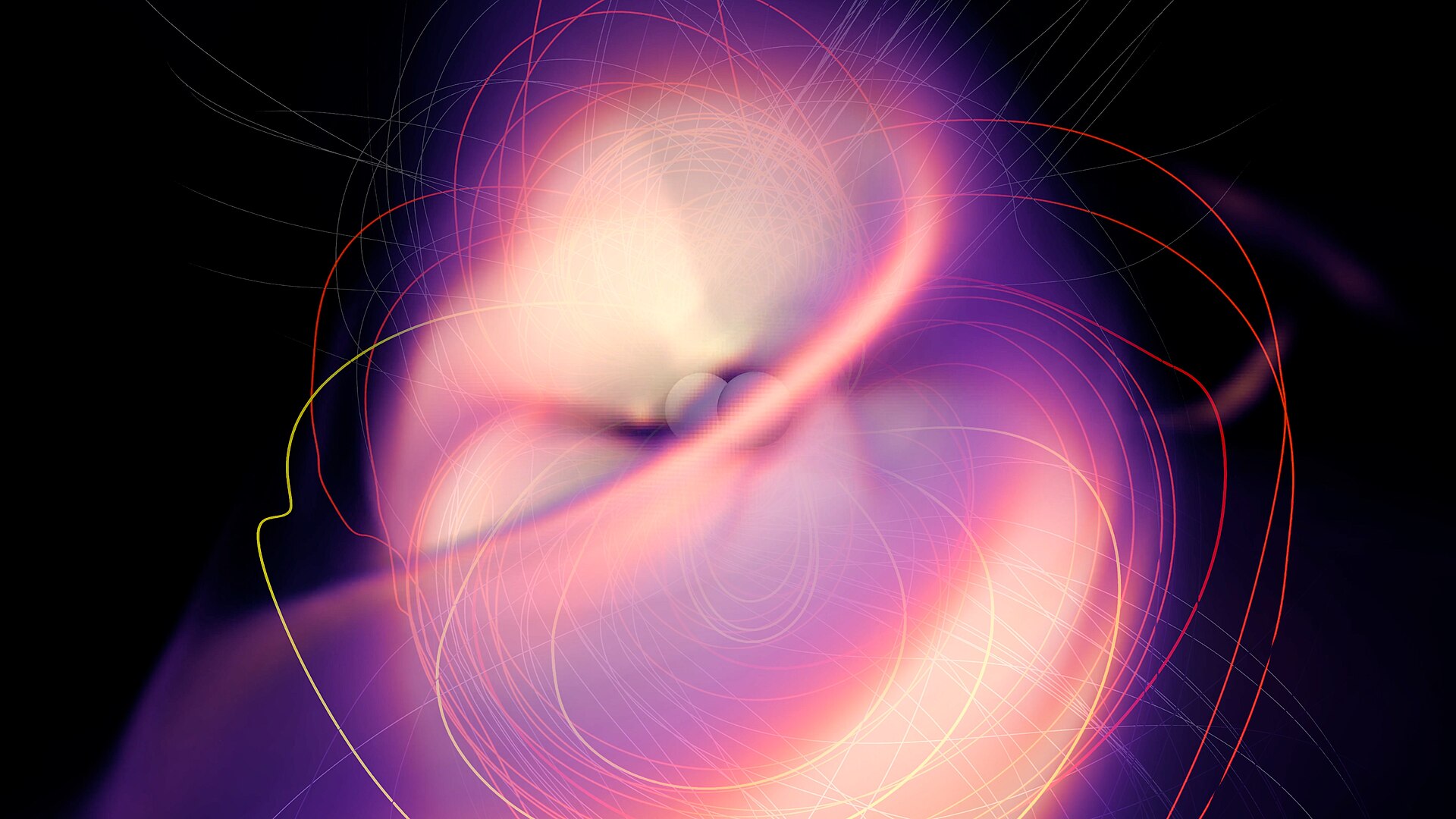
General relativity has an unusual prediction buried in it: mass in motion should radiate. Not light, but ripples in the geometry of spacetime itself, spreading outward at the speed of light and stretching and squeezing everything they pass through.
Einstein published the prediction in 1916 and doubted it would ever be observed. He was nearly right — it took a century.
What a gravitational wave does
Spacetime is not a passive backdrop. Mass and energy curve it, and changes in that curvature propagate outward as waves.
When a wave passes, it distorts space perpendicular to its direction of travel, stretching along one axis while compressing along the other, then reversing. A ring of free-floating particles would oscillate into an ellipse and back.
The effect is real but astonishingly small. A strong gravitational wave from a black hole merger hundreds of millions of light years away changes the length of a four-kilometre baseline on Earth by less than one ten-thousandth the width of a proton. Detecting that is the entire engineering problem.
How you measure something that small
The instruments are laser interferometers, and the principle is elegant.
A laser beam is split and sent down two perpendicular arms, each several kilometres long. Mirrors at the far ends reflect the beams back, and the two are recombined. Under normal conditions the recombined beams cancel out. If a gravitational wave changes the relative length of the arms, even fractionally, the cancellation becomes imperfect and light appears at the detector.
Making this work against every other source of noise on a geologically active planet required a remarkable set of measures:
- Mirrors suspended on multi-stage pendulums to isolate them from ground motion.
- Ultra-high vacuum along the entire beam path, so air currents and refractive index changes do not swamp the signal.
- Optical cavities that bounce the light back and forth hundreds of times, effectively multiplying the arm length.
- Quantum noise reduction techniques to push below the limits imposed by the statistics of photon arrival.
- Multiple detectors on different continents, so that a real astrophysical signal must appear in all of them with the correct light-travel delay.
That last point is what makes detections credible. A truck passing one facility does not register at another site thousands of kilometres away.
The first detection and what followed
In September 2015, both detectors of the LIGO observatory recorded a signal lasting a fraction of a second: a rising frequency sweep, ending in a sharp cutoff. It matched the predicted waveform for two black holes of roughly thirty solar masses each spiralling together and merging, more than a billion light years away.
In the final moments before merging, the pair radiated more power in gravitational waves than all the light from every star in the observable universe combined.
The announcement in early 2016 confirmed both the existence of gravitational waves and the existence of stellar-mass black hole binaries, neither of which had been directly observed before.
Detections are now routine, numbering in the hundreds. The population revealed has been informative: black holes heavier than stellar evolution models comfortably predicted, and objects in mass ranges that were expected to be empty.
The event that opened a new field
In August 2017, detectors recorded a signal with a different character — longer, and matching two neutron stars rather than black holes. Within seconds, gamma-ray satellites detected a burst from the same region of sky.
Telescopes across the world and in orbit swung to the location and found the optical counterpart within hours. Over the following days they watched the glow fade and redden in a pattern matching the radioactive decay of freshly synthesised heavy elements.
That single event confirmed that neutron star mergers produce short gamma-ray bursts, demonstrated that they are a major site for forging elements heavier than iron, provided an independent measurement of the expansion rate of the universe, and constrained the speed of gravitational waves to match the speed of light to within one part in a quadrillion.
It was the beginning of multi-messenger astronomy — observing the same event through gravity and light simultaneously.
What is coming
Ground-based detectors are limited at low frequencies by seismic noise, which caps the mass range they can observe. Supermassive black hole mergers radiate at frequencies far too low to detect from Earth.
Two approaches address this. Pulsar timing arrays use millisecond pulsars scattered across the galaxy as a natural detector, watching for correlated timing variations caused by very low frequency waves. And a planned space-based interferometer with arms millions of kilometres long would open the band between the two.
Every time astronomy has gained access to a new part of the spectrum, it has found things nobody predicted. Gravitational waves are not part of the spectrum at all — they are an entirely separate channel.
Leave a Reply