Author: Derrick Kong

  • Inside Artemis: How Humanity Plans to Return to the Moon

    Inside Artemis: How Humanity Plans to Return to the Moon

    More than half a century after the last Apollo crew left the lunar surface, NASA’s Artemis program is working to put astronauts back on the Moon — this time with the goal of staying. Artemis is not a single rocket or a single landing. It is a stack of interlocking systems, international partnerships, and commercial contracts, all pointed at a region no crew has ever visited: the lunar south pole.

    The hardware at the core

    Three pieces of hardware do the heavy lifting. The Space Launch System is a heavy-lift rocket built around a core stage derived from Space Shuttle main engine technology, flanked by a pair of solid rocket boosters. Riding on top is Orion, a crew capsule designed for deep space rather than low Earth orbit, with a European Service Module supplying power, propulsion, and life support.

    Neither of those can land. That job falls to a Human Landing System, procured commercially rather than built in-house — a significant departure from the Apollo model, where NASA owned the whole vehicle. The lander meets Orion in lunar orbit, carries the crew down to the surface, and brings them back up.

    Why the south pole

    Apollo landed near the lunar equator, in sunlit terrain that was relatively easy to reach and navigate. Artemis is aiming somewhere far more awkward, and for a good reason: water.

    The Moon’s axis is tilted only slightly, which means the floors of some polar craters have not seen sunlight in billions of years. Those permanently shadowed regions act as cold traps, and orbital data has consistently pointed to water ice accumulating inside them. Ice is drinking water, breathable oxygen, and — split into hydrogen and oxygen — rocket propellant. A base that can manufacture its own consumables is far cheaper to sustain than one supplied entirely from Earth.

    The difference between Apollo and Artemis is the difference between visiting and moving in.

    The polar region also offers ridges and crater rims that receive near-continuous sunlight, which matters enormously for solar power and for surviving the two-week lunar night.

    The step-by-step plan

    Artemis is deliberately sequenced, with each mission retiring risk for the next.

    • An uncrewed test flight sent Orion around the Moon and back to validate the capsule, its heat shield, and the SLS launch system.
    • A crewed flight follows the same broad trajectory with astronauts aboard, testing life support and deep-space operations without attempting a landing.
    • A subsequent mission carries a crew to lunar orbit, transfers them to a lander, and puts boots on the surface near the south pole.
    • Later missions add infrastructure: a small station in lunar orbit, surface mobility, and eventually habitats designed for longer stays.

    Gateway and the long game

    Gateway is the piece that most clearly signals long-term intent. It is a compact space station planned for a highly elliptical near-rectilinear halo orbit around the Moon — an orbit chosen because it is stable, energy-efficient to reach, and offers continuous communication with Earth.

    Gateway is not a destination in itself. It is a staging post: somewhere landers can dock, crews can transfer, and science payloads can operate between surface expeditions. It is also the most international element of the program, with modules and contributions from European, Japanese, and Canadian agencies.

    What could slow it down

    Ambitious programs slip, and Artemis has been no exception. The landing system, the new spacesuits, and the orbital refueling techniques that some lander architectures require are all genuinely hard engineering problems being solved in parallel. Schedules have moved more than once, and they may move again.

    That is worth stating plainly rather than glossing over. But the underlying shift is real: the Moon is being approached this time as a place to work rather than a place to visit, with reusable elements, commercial partners, and a target region chosen for its resources rather than its convenience.

    If Artemis succeeds on its own terms, the milestone will not be a single set of footprints. It will be the second crew arriving, and finding the lights already on.

  • The Space Telescope Rewriting Cosmic History

    The Space Telescope Rewriting Cosmic History

    For most of astronomy’s history, the atmosphere was an unavoidable tax. Air blurs starlight, and water vapour swallows the infrared wavelengths that carry some of the most interesting information in the universe. Putting a large, cold, infrared-tuned telescope above all of that has changed what astronomers can realistically ask.

    An observatory built cold

    The James Webb Space Telescope’s defining feature is not just its 6.5-metre primary mirror — assembled from eighteen gold-coated beryllium hexagons that unfolded after launch — but the fact that the whole instrument runs frigid.

    A five-layer sunshield roughly the size of a tennis court separates the telescope from the Sun, Earth, and Moon. On the shaded side, the optics settle to around 40 kelvin, only a few dozen degrees above absolute zero. This matters because a warm telescope glows in the infrared, drowning out the faint signals it is trying to collect. To see in the infrared, the instrument must be colder than what it is looking at.

    The observatory operates near the second Lagrange point, about 1.5 million kilometres from Earth on the far side from the Sun. That location keeps the Sun, Earth, and Moon conveniently clustered in one direction, so a single shield can block all three.

    Why infrared changes the story

    Two separate effects make infrared the right choice for peering into the deep past.

    • The universe is expanding, so light from distant galaxies is stretched on its way to us. Ultraviolet and visible light emitted by the first stars arrives redshifted into the infrared.
    • Dust that blocks visible light is far more transparent in the infrared, letting astronomers see into the dense clouds where stars and planets are actively forming.

    The result is a telescope well suited to two very different frontiers: the earliest galaxies, and the nurseries where new solar systems are being assembled right now.

    Early galaxies that were not supposed to be there

    One of the most consequential results has been the sheer number of bright, apparently well-developed galaxies found at very high redshift — meaning they existed only a few hundred million years after the Big Bang.

    Before these observations, models generally expected the early universe to be populated by small, faint, disorganised clumps that would take longer to assemble into recognisable galaxies. Finding more mass and more structure earlier than predicted has forced a genuine reassessment.

    Every time a telescope looks further back than the last one, the early universe turns out to have been busier than expected.

    The debate is still live. Some of these objects may be less massive than they first appear, with light from rapidly growing black holes inflating the estimates. Others may point to star formation being more efficient in the early universe than models allowed. Either resolution is scientifically interesting.

    Sniffing the air of other worlds

    The second frontier is closer to home. When a planet passes in front of its star, a sliver of starlight filters through the planet’s atmosphere on its way to us. Molecules in that atmosphere absorb specific wavelengths, leaving a chemical fingerprint in the spectrum.

    The signals are tiny — often a fraction of a percent of the star’s brightness — which is precisely why a large, stable, cold, space-based telescope matters. Detections of carbon dioxide, water vapour, and other molecules in exoplanet atmospheres have moved this technique from a proof of concept to routine science.

    What comes next

    Webb was designed for a nominal five-year science mission, with a ten-year goal. An unusually efficient launch left it with more propellant margin than planned, which extends the realistic operating life considerably.

    It also does not work alone. Webb sees the infrared; Hubble still covers the ultraviolet and visible; ground-based extremely large telescopes now under construction will bring enormous apertures to bear from beneath the atmosphere, using adaptive optics to claw back some of the sharpness they lose to air. The interesting results increasingly come from combining them.

  • Europa’s Hidden Ocean: Why a Moon of Jupiter Could Harbor Life

    Europa’s Hidden Ocean: Why a Moon of Jupiter Could Harbor Life

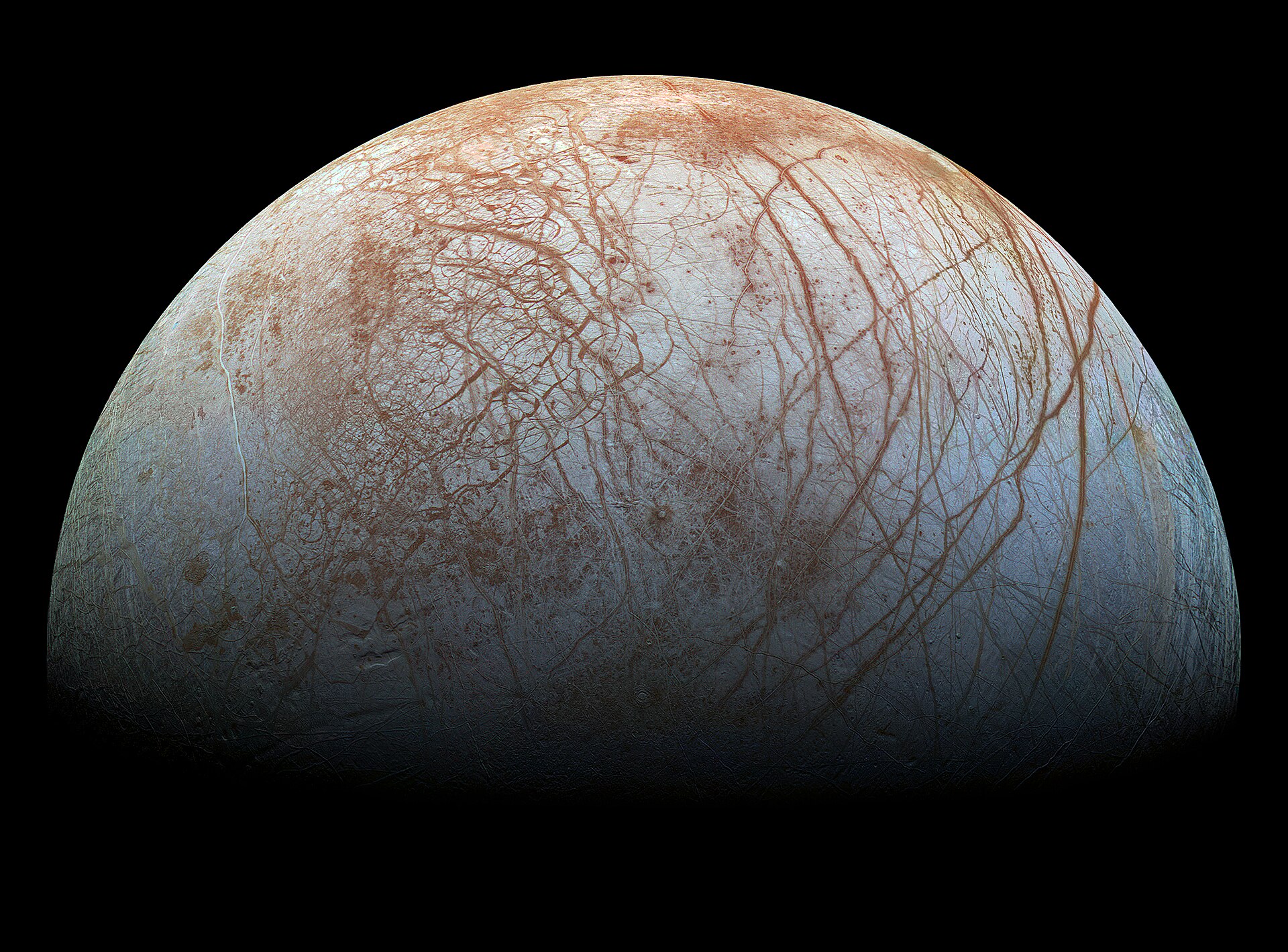
    Europa is slightly smaller than Earth’s Moon, and from a distance it looks like a cracked billiard ball — a bright, startlingly smooth surface scored with rust-coloured lines. That smoothness is the first clue. Something has been resurfacing this moon, recently and repeatedly, and the leading explanation is a global ocean of liquid saltwater hidden beneath the ice.

    The case for an ocean

    The evidence arrived in stages, and no single piece would be convincing on its own.

    The surface has remarkably few impact craters. Every solid body in the solar system gets hit; a surface without scars is a surface that is being erased and remade. Europa’s terrain looks geologically young, which requires an active interior.

    The surface is also fractured in patterns that make sense if a rigid shell is floating on something that can flow. Long ridges, rotated blocks, and regions of jumbled “chaos terrain” all suggest ice that has cracked, drifted, and refrozen.

    The most direct evidence came from magnetic measurements. As Europa moves through Jupiter’s powerful and tilted magnetic field, it generates an induced magnetic field of its own. That only works if the moon contains a substantial layer of electrically conductive material near the surface — and salty liquid water fits the requirement neatly. Rock does not.

    How much water

    Estimates put the ice shell somewhere in the range of fifteen to twenty-five kilometres thick, with an ocean beneath it perhaps sixty to a hundred and fifty kilometres deep. Even at the conservative end, that is more liquid water than all of Earth’s oceans combined, on a moon a quarter of Earth’s diameter.

    Europa may hold twice the water of every ocean on Earth, sealed under a lid of ice.

    What keeps it liquid

    Europa sits far outside the zone where sunlight could keep water liquid. The energy comes from somewhere else: tides.

    Europa, Io, and Ganymede are locked in a resonance, completing one, two, and four orbits of Jupiter respectively in the same period. That regular gravitational nudging keeps their orbits slightly elliptical rather than letting them circularise. An elliptical orbit means the strength of Jupiter’s tidal pull changes over the course of each circuit, so Europa is continuously flexed. That flexing generates heat through friction, exactly the way a paperclip warms when you bend it back and forth.

    Io, closer in, is squeezed so hard it is the most volcanically active body in the solar system. Europa gets a gentler version — enough to keep an ocean from freezing solid.

    Why that makes it a target for life

    Life as we understand it needs three broad ingredients: liquid water, a source of energy, and the right chemical elements. Europa plausibly has all three.

    • Water is the strongest part of the case.
    • Chemistry looks promising, since the ocean is likely in contact with a rocky seafloor, allowing water-rock reactions of the kind that support hydrothermal ecosystems on Earth.
    • Energy is the open question. Sunlight cannot reach the ocean, so any biosphere would need chemical energy — but Jupiter’s radiation processes the surface ice into oxidants, and if that material cycles downward, it could feed reactions below.

    The reddish-brown streaks along Europa’s cracks may be salts and sulphur compounds from the ocean, altered by radiation after reaching the surface. If so, the surface is offering samples of the interior without anyone having to drill.

    The hard part

    Studying Europa is difficult for a reason that has nothing to do with distance. Jupiter’s radiation belts are brutally intense, and spacecraft electronics degrade quickly in that environment. The practical workaround is to orbit Jupiter rather than Europa, dipping past the moon on repeated close flybys and spending most of each orbit in safer territory.

    Actually reaching the ocean is a much harder problem still — a lander able to drill or melt through kilometres of ice, sterilised thoroughly enough not to contaminate what it finds. That mission does not exist yet. But the reconnaissance to decide whether it is worth building is already under way.

  • How to See a Meteor Shower at Its Peak

    How to See a Meteor Shower at Its Peak

    Meteor showers are the most democratic event in astronomy. No telescope, no app, no expensive optics, no technical skill. The main requirements are a dark spot, a clear sky, and the willingness to be outside at an inconvenient hour.

    Here is how to get the most out of one.

    What you are actually watching

    A meteor shower happens when Earth ploughs through a trail of debris left behind by a comet — or, in a couple of cases, an asteroid. The particles are mostly tiny, often no bigger than a grain of sand. They hit the atmosphere at tens of kilometres per second, compress the air in front of them, and vaporise in a streak of glowing gas roughly eighty to a hundred kilometres up.

    Nothing is falling on you. The “shooting star” is a very small object being destroyed very fast, very high.

    Because the debris stream is travelling in a specific direction, all the meteors in a shower appear to radiate from one point in the sky, called the radiant. That is a perspective effect, the same reason parallel railway tracks seem to converge. Showers are named for the constellation the radiant sits in — Perseids from Perseus, Geminids from Gemini.

    The showers worth planning around

    A handful of showers reliably deliver.

    • The Perseids peak in mid-August, with warm northern-hemisphere nights and fast, bright meteors. Debris comes from Comet Swift-Tuttle.
    • The Geminids peak in mid-December and are often the richest shower of the year, producing slower, sometimes yellowish meteors. Their parent is the odd rocky object 3200 Phaethon.
    • The Quadrantids in early January can be intense but have a very sharp peak, often only a few hours wide.
    • The Orionids in October and the Lyrids in April are more modest but still worth an evening.

    Timing matters more than anything

    Two factors dominate whether you see a good show or a disappointing one, and both are predictable well in advance.

    The first is the Moon. A bright Moon washes out faint meteors just as effectively as a streetlight. A shower peaking near new Moon is worth travelling for; the same shower peaking near full Moon may be barely noticeable. Check the phase before committing.

    The second is the hour. Rates almost always improve after local midnight and are usually best in the hours before dawn. The reason is geometry: after midnight you are on the leading side of Earth as it moves along its orbit, sweeping into the debris head-on. Before midnight, meteors have to catch up from behind.

    The pre-dawn hours are not a hardcore observer’s affectation. They genuinely produce several times more meteors.

    Where to stand, and how to look

    Get away from direct light. You do not necessarily need a certified dark-sky site — a rural field, a park away from streetlamps, or even a garden with the house between you and the nearest floodlight will noticeably help.

    Then let your eyes adapt. Full dark adaptation takes twenty to thirty minutes and is undone in seconds by a phone screen. If you need light, use a red torch or a phone in red-shift mode at minimum brightness.

    Do not look at the radiant. Meteors near the radiant appear foreshortened as short stubs; those forty to sixty degrees away from it show much longer trails. Look at a broad patch of sky roughly halfway up, in a direction with the fewest obstructions.

    Lie down. A reclining chair, a sleeping bag, or a picnic blanket lets you take in a wide field of sky without craning your neck for an hour.

    Managing expectations

    Published rates are given as a zenithal hourly rate, which is the number a perfect observer would see under perfect conditions with the radiant directly overhead. Real numbers under a real sky are lower, often by half or more. A “hundred per hour” shower might realistically deliver twenty to forty from a decent dark site.

    That is still roughly one every couple of minutes, which is plenty. Dress warmer than you think you need to, bring something hot to drink, and give it at least an hour — meteors arrive in clumps, and quitting after fifteen quiet minutes is the most common mistake.

  • Black Holes Explained: From Stellar Collapse to Cosmic Giants

    Black Holes Explained: From Stellar Collapse to Cosmic Giants

    A black hole is what happens when gravity wins completely. Pack enough mass into a small enough volume and the escape velocity at the boundary exceeds the speed of light. Since nothing travels faster than light, nothing gets out. The object stops being a thing you can look at and becomes a region you can only observe indirectly.

    The event horizon is not a surface

    The most common misconception about black holes is that the event horizon is a physical object — a shell, a wall, something you could touch. It is not. It is a boundary in spacetime, the point of no return, and an infalling observer would notice nothing locally remarkable about crossing it.

    Its size scales simply with mass. For a black hole with the mass of the Sun, the horizon radius is about three kilometres. Ten solar masses gives thirty kilometres. The relationship is linear, which leads to a counterintuitive consequence: the largest black holes have low average densities, because volume grows faster than radius.

    What lies inside is genuinely unknown. General relativity predicts a singularity — a point of infinite density — but that prediction is widely understood as a signal that the theory has been pushed past its limits rather than a description of reality. Resolving it requires a theory of quantum gravity that does not yet exist.

    Three sizes, three origin stories

    Stellar-mass black holes

    When a massive star exhausts its nuclear fuel, its core can no longer resist its own weight. The collapse is catastrophic and fast, and if the remaining core is heavy enough — above roughly two to three solar masses — no known force can stop it. The result is a black hole of a few to a few tens of solar masses.

    These are the ones detected regularly by gravitational-wave observatories when two of them spiral together and merge.

    Supermassive black holes

    At the centre of essentially every large galaxy sits something millions to billions of times the mass of the Sun. The Milky Way’s own, Sagittarius A*, is around four million solar masses. The one at the centre of the galaxy M87 is closer to six and a half billion.

    How they grew so large so early is an unresolved problem. Ordinary stellar collapse followed by steady accretion appears too slow to explain the massive black holes observed in the young universe, which has pushed astronomers toward models involving direct collapse of enormous gas clouds or rapid mergers.

    The awkward middle

    Intermediate-mass black holes — hundreds to hundreds of thousands of solar masses — should exist as a bridge between the other two categories, but confirmed examples remain scarce. Gravitational-wave detections have started filling in part of the gap.

    How you see something invisible

    Black holes are detected by their effects.

    • Stars orbiting an unseen mass. Decades of tracking stars whipping around the galactic centre revealed an object of millions of solar masses confined to a very small volume.
    • Accretion. Gas falling toward a black hole forms a disk, heats through friction to millions of degrees, and radiates ferociously in X-rays. Some of the brightest objects in the universe are powered this way.
    • Jets. Many accreting black holes launch collimated beams of particles at near light speed, extending far beyond their host galaxies.
    • Gravitational waves. Merging black holes radiate ripples in spacetime that detectors on Earth can now measure directly.
    • Direct imaging. Planet-scale networks of radio telescopes have resolved the shadow cast by a black hole against the glowing material around it — first for M87*, later for Sagittarius A*.

    A black hole is the only object in nature that can be completely described by three numbers: mass, spin, and electric charge.

    That last statement is the “no-hair theorem,” and it makes black holes the simplest macroscopic objects known. Everything else about whatever fell in — its composition, its structure, its history — appears to be erased.

    The open question

    Black holes are not entirely eternal. Quantum effects near the horizon should cause them to radiate very slowly and eventually evaporate. For any astrophysical black hole this process is unimaginably slow, far longer than the current age of the universe.

    But it creates a deep theoretical problem. If a black hole evaporates completely, what happens to the information about everything that fell in? Quantum mechanics says information cannot be destroyed; the naive black hole calculation says it is. Reconciling the two remains one of the most active arguments in theoretical physics, and the answer will likely say as much about the nature of spacetime as it does about black holes.

  • A Mission to an Ocean World: Exploring Europa From Orbit

    A Mission to an Ocean World: Exploring Europa From Orbit

    Deciding whether Europa’s hidden ocean could support life requires more than orbital snapshots. It requires measuring the thickness of the ice, mapping the ocean beneath it, sampling whatever escapes to the surface, and doing all of it in one of the harshest radiation environments in the solar system.

    That is the job of Europa Clipper, the largest planetary spacecraft NASA has built.

    Orbiting Jupiter, not Europa

    The mission’s central design decision looks counterintuitive at first: the spacecraft will not orbit Europa. It will orbit Jupiter on a long, looping path, dipping past Europa for close flybys and then retreating.

    The reason is radiation. Jupiter’s magnetosphere accelerates charged particles to enormous energies, and Europa sits inside the worst of it. A spacecraft parked in Europa orbit would accumulate a lethal dose to its electronics in a matter of weeks. By spending most of each orbit far from Jupiter and only sprinting through the danger zone, Clipper can accumulate dozens of close passes over years rather than dying after a few.

    Even so, the most sensitive electronics are housed in a thick-walled vault of titanium and aluminium — essentially a radiation-shielded safe at the heart of the spacecraft.

    What it carries

    The instrument suite is built to answer three questions: how thick is the ice, what is the ocean like, and what is the surface made of.

    • An ice-penetrating radar designed to profile the shell and look for water pockets within it, or the boundary at its base.
    • A magnetometer to refine the induced-field measurements that first indicated a conductive ocean, tightening the constraints on its depth and salinity.
    • Mass spectrometers to sample gas and dust around the moon, including any material lofted from plumes or knocked off the surface by micrometeorites.
    • Cameras and spectrometers covering visible, ultraviolet, and infrared wavelengths to map composition and geology at high resolution.
    • A thermal imager to hunt for warm spots that might mark recent activity or thin ice.

    Notably, several of these instruments can sample Europa’s material without landing. If plumes vent from the subsurface, flying through one turns a flyby into a sampling mission.

    The spacecraft’s solar arrays span more than thirty metres — necessary because sunlight at Jupiter is roughly one twenty-fifth as strong as at Earth.

    Getting there

    Jupiter is a long way, and a direct transfer is expensive in fuel. Clipper takes an indirect route, using gravity assists to build up speed over several years before arrival. Once in the Jovian system, the orbit is gradually reshaped by repeated encounters, bringing the spacecraft over different parts of Europa on each pass so the coverage accumulates into a global map.

    The plan calls for roughly fifty close flybys, some passing within a few tens of kilometres of the surface.

    Not travelling alone

    Europa Clipper shares the Jupiter system with the European Space Agency’s JUICE mission, which launched earlier and is focused primarily on Ganymede, with flybys of Callisto and Europa along the way. Ganymede is the only moon known to generate its own internal magnetic field, and it is thought to hold a deep ocean of its own.

    Two spacecraft studying the same system with complementary instruments is a substantial upgrade over anything since Galileo, the orbiter that first made the case for Europa’s ocean in the 1990s.

    What it will not do

    It is worth being precise about the mission’s limits. Europa Clipper is not a life-detection mission. It carries no instrument capable of confirming biology, and it will not land, drill, or reach the ocean.

    Its purpose is habitability assessment: determining whether the environment has the ingredients life requires. That distinction matters, because the results will shape what gets built next. If the ice turns out to be thin in places, or plumes are confirmed as a reliable sampling route, the case for a lander becomes far stronger — and far better targeted.

    The reconnaissance has to come first.

  • What Is Dark Matter? The Invisible Scaffolding of the Cosmos

    What Is Dark Matter? The Invisible Scaffolding of the Cosmos

    Add up everything that emits, absorbs, or reflects light — every star, planet, gas cloud, and dust grain — and you account for roughly five percent of the universe’s energy budget. Another twenty-seven percent is matter that appears to interact with the rest of the cosmos through gravity alone. We call it dark matter, and the name is mostly an admission of ignorance.

    How we know something is missing

    The evidence is not a single anomaly. It comes from independent measurements at wildly different scales, and they agree.

    Galaxies spin too fast

    In the solar system, planets further from the Sun orbit more slowly, because nearly all the mass is concentrated at the centre. Spiral galaxies should behave similarly, with stars in the outskirts orbiting more slowly than those near the core.

    They do not. Careful measurements of rotation curves showed that orbital speeds stay roughly flat far out into the disk, where there is very little visible material. Either gravity behaves differently on those scales, or there is a great deal of unseen mass arranged in a halo extending well beyond the visible galaxy.

    Clusters hold together

    The same problem appears one level up. Galaxies in large clusters move fast enough that the cluster’s visible mass could not gravitationally contain them — the whole structure should have flown apart long ago. This discrepancy was noticed in the 1930s, decades before the rotation-curve work, and was largely set aside at the time.

    Light bends around invisible mass

    Mass warps spacetime, and warped spacetime deflects light. Mapping the distortion of background galaxies lets astronomers weigh a foreground cluster without any assumption about what it is made of. Those maps consistently show far more mass than the visible matter can supply, distributed in a way that traces the galaxies but extends beyond them.

    The most pointed example is a pair of colliding clusters where the hot gas — which is most of the ordinary matter — piled up in the middle on impact, while the lensing mass sailed straight through and ended up on either side. That separation is difficult to explain by modifying gravity, and straightforward to explain if most of the mass is something that barely interacts.

    The early universe left a pattern

    The cosmic microwave background carries a fossil imprint of sound waves in the primordial plasma. The relative heights of the peaks in that pattern depend on how much ordinary matter and how much non-interacting matter were present. The fit demands both, in roughly the proportions inferred from every other method.

    Five independent lines of evidence, spanning individual galaxies to the whole observable universe, converge on the same answer.

    What it might be

    The observational constraints are tight. Dark matter must be effectively invisible to light, must be slow-moving in the early universe to allow structure to form as it did, must be stable over billions of years, and must not clump the way ordinary matter does.

    Leading candidates include:

    • Weakly interacting massive particles, long the favoured option, though decades of increasingly sensitive detectors have found nothing.
    • Axions, very light particles originally proposed to solve an unrelated problem in particle physics, now the focus of a growing set of experiments.
    • Sterile neutrinos, hypothetical relatives of known neutrinos that interact even more weakly.
    • Primordial black holes formed in the first instants after the Big Bang, though observational limits have squeezed the viable mass ranges considerably.

    The alternative view

    A minority position holds that there is no missing matter and that our theory of gravity is incomplete on galactic scales. Modified-gravity approaches can reproduce galaxy rotation curves impressively well, sometimes better than dark-matter models without fine-tuning.

    Where they struggle is everything else — cluster dynamics, colliding clusters, the microwave background peaks, and the growth of large-scale structure. Most researchers therefore treat dark matter as the stronger hypothesis while acknowledging that the rotation-curve regularities modified gravity captures are a real pattern that dark-matter models should also explain.

    Where this goes

    The frustrating truth is that the most successful cosmological model in history rests on two components — dark matter and dark energy — whose nature is unknown. Detection experiments are getting steadily more sensitive, galaxy surveys are mapping the distribution of unseen mass in ever finer detail, and colliders continue to look for anything that leaves without interacting.

    A null result is not nothing. Every experiment that fails to find a particle rules out a slice of parameter space, and the space is finite.

  • A Beginner’s Guide to Choosing Your First Telescope

    A Beginner’s Guide to Choosing Your First Telescope

    The most common way to end up disappointed with a first telescope is to buy the one with the biggest number printed on the box. Those numbers almost always describe magnification, which is the least important specification a telescope has.

    Here is what actually matters.

    Aperture is the specification that counts

    Aperture is the diameter of the main lens or mirror, and it determines two things: how much light the telescope gathers, and how fine a detail it can resolve. Everything else is secondary.

    A larger aperture shows fainter galaxies, more detail in Jupiter’s cloud bands, and cleaner splits of close double stars. Doubling the aperture quadruples the light-gathering area, which is a genuinely dramatic difference at the eyepiece.

    Magnification, by contrast, is not a fixed property of the telescope at all. It is simply the telescope’s focal length divided by the eyepiece’s focal length, and you change it by swapping eyepieces. Any telescope can be pushed to 600x. The image will just be a dim, wobbly blur. The practical ceiling is roughly 50x per inch of aperture, and atmospheric turbulence often caps you well below that.

    If a telescope is advertised by its magnification rather than its aperture, that is a signal about who it was built for.

    The three basic designs

    Refractors

    A lens at the front, an eyepiece at the back. Refractors are sealed, need essentially no maintenance, hold their alignment indefinitely, and give crisp, high-contrast views. They are excellent on the Moon, planets, and double stars.

    The catch is cost per centimetre of aperture. Good glass is expensive, and large refractors become impractical quickly. Cheaper ones can show colour fringing around bright objects.

    Reflectors

    A curved mirror at the bottom of a tube, with a small secondary mirror directing light out to the side. The Newtonian reflector is by a wide margin the most aperture per unit of money, which is why it dominates recommendations for beginners.

    Trade-offs: the mirrors need occasional realignment, a process called collimation, and the open tube means the optics need time to cool to ambient temperature before views sharpen.

    Catadioptrics

    Schmidt-Cassegrain and Maksutov designs fold the light path using both mirrors and a corrector plate, packing a long focal length into a short, portable tube. They are compact and versatile, and they pair well with computerised mounts. They cost more than a reflector of equal aperture and take longer to cool down.

    The mount matters as much as the optics

    A superb telescope on a flimsy mount is unusable. Every touch sets off a vibration that takes seconds to settle, and at high magnification even a light breeze becomes visible.

    There are two broad approaches:

    • Altazimuth mounts move up-down and left-right. Simple and intuitive. The Dobsonian — a Newtonian reflector on a simple wooden altazimuth base — is the classic recommendation because it puts nearly the entire budget into aperture.
    • Equatorial mounts tilt one axis to match Earth’s rotation axis, so a single slow motion tracks a target across the sky. This is essential for long-exposure astrophotography and useful for high-magnification planetary viewing, but it takes setup and alignment each session.

    Computerised go-to mounts will find objects for you, which sounds ideal but consumes budget that could have gone into aperture, and requires alignment before every session.

    A realistic first setup

    For most people starting out, a six- or eight-inch Dobsonian is the strongest recommendation available. It is simple enough to be carried outside and used in five minutes, large enough to show real detail, and cheap enough per centimetre of aperture that nothing else competes.

    Two caveats. First, an eight-inch Dobsonian is bulkier than people expect — check whether you can realistically carry it to where you observe. Second, if the honest answer is that you will only use it two or three times a year, a good pair of 10×50 binoculars on a tripod will see far more use and cost a fraction as much.

    The accessories that are actually worth it

    Most bundled accessories are filler. Three things are not:

    • A decent low-power eyepiece for finding things and for wide views of star clusters.
    • A red torch, to preserve dark adaptation.
    • A star chart or planetarium app, so you know what is up tonight and where to point.

    Skip the coloured planetary filters and the excessive Barlow lenses for now. Learn the sky first; the equipment upgrades will make more sense once you know what you want to look at.

  • Mars in Focus: What Robotic Rovers Have Taught Us

    Mars in Focus: What Robotic Rovers Have Taught Us

    Before the rovers, Mars was a set of arguments about smudges. Telescopic observers saw features that some interpreted as canals and vegetation. Orbiters replaced that with geology — channels, volcanoes, layered terrain — but geology from orbit can only take you so far. To read the rock record, you have to get down and look closely at the rocks.

    From proof of concept to field geology

    The first successful rover was tiny, roughly the size of a microwave, and operated for weeks rather than years. Its scientific return was modest by later standards, but it demonstrated the essential thing: a mobile vehicle could survive landing, drive on Martian soil, and take measurements at targets chosen after arrival.

    The generation that followed was larger, solar-powered, and built for a ninety-day nominal mission. Both dramatically outlasted that. One spent years crossing a plain and descending into craters; the other operated for well over a decade, long enough to walk the rim of a large crater and study rocks from a much older period of Martian history.

    The current generation is nuclear-powered, car-sized, and equipped with laboratory instruments — drills, spectrometers that fire lasers at rock from a distance, and in one case a device for caching samples for eventual return to Earth.

    What they found: water, repeatedly

    The single largest shift in our understanding is that Mars was once wet, and not briefly.

    The evidence is physical rather than inferential. Rovers have driven over rounded pebbles of the kind that only form when water tumbles them downstream. They have imaged cross-bedded sandstone laid down by flowing currents, and mudstones deposited in still water. They have found veins of calcium sulphate cutting through rock, precipitated by groundwater moving through fractures long after the sediments formed.

    One rover found hematite spherules — nicknamed blueberries — that form in water-saturated rock. Another spent years climbing a mountain of layered sediment inside a crater, effectively reading upward through millions of years of environmental change recorded in the strata.

    A crater floor that looked from orbit like flat dust turned out, at wheel level, to be the bed of an ancient lake.

    Habitable, not inhabited

    The distinction that has emerged is careful and important. Rovers have established that early Mars had environments that could have supported microbial life: liquid water at neutral pH, chemical energy gradients, and the necessary elements including carbon, hydrogen, nitrogen, oxygen, phosphorus, and sulphur.

    Establishing habitability is not the same as detecting life. No rover has found unambiguous biosignatures, and the instruments carried so far are not really capable of settling the question. Organic molecules have been detected in Martian rock, which is significant, but organics can form without biology.

    The methane puzzle

    One of the more frustrating open threads is methane. Some measurements have detected low, seasonally varying concentrations in the atmosphere near the surface. Methane breaks down relatively quickly under Martian conditions, so its presence implies an active source — geological, biological, or something not yet identified.

    Complicating matters, orbital measurements have struggled to confirm the surface detections at the levels reported. Reconciling the two remains unresolved.

    Why samples need to come home

    The consistent lesson across missions is that the most decisive analyses cannot be done on Mars. Rover instruments are miniaturised, power-limited, and fixed at launch. Terrestrial laboratories have room-sized equipment, can repeat measurements, can apply techniques invented after the sample was collected, and can be independently checked by other labs.

    That is the reasoning behind sample caching: sealing carefully selected cores in tubes and leaving them for a future mission to retrieve. The return architecture is technically difficult and has been repeatedly reconsidered on cost grounds, but the scientific argument for it has not weakened.

    What the rovers changed

    The cumulative effect of three decades of surface exploration is that Mars stopped being a planet we speculate about and became a planet with a documented history. There were rivers. There were lakes. There was groundwater circulating through rock for extended periods. Something then changed — the loss of a magnetic field, the stripping of the atmosphere, the freezing out of surface water — and the planet we see now is the aftermath.

    Understanding how a world that resembled early Earth became the cold desert it is today is worth the effort on its own, entirely apart from whether anything ever lived there.

  • The Night Sky This Season: Planets and Phases to Watch

    The Night Sky This Season: Planets and Phases to Watch

    Naked-eye astronomy is underrated. Most people’s first instinct is that seeing anything interesting requires equipment, and then the equipment sits unused in a cupboard. The truth is that the sky offers a rotating programme of things worth looking at, and knowing what is up tonight is most of the skill.

    Here is a framework for observing any season, rather than a list that goes stale in a fortnight.

    Start with the planets

    Five planets are visible without any optical aid, and they are the easiest wins available.

    • Venus is unmistakable — the brightest thing in the sky after the Sun and Moon, appearing either in the west after sunset or the east before sunrise, never far from the Sun.
    • Jupiter is the next brightest, holds steady, and rewards even modest binoculars by showing its four largest moons as a line of pinpricks that shifts night to night.
    • Mars varies enormously. Near opposition it is a striking orange beacon; at other times it is unremarkable.
    • Saturn is a steady yellowish point to the eye. Any small telescope shows the rings, which is the single most reliable way to convert a sceptic.
    • Mercury is the difficult one, always low and lost in twilight, visible only during brief windows near its greatest elongations.

    The reliable way to tell a planet from a star is that stars twinkle and planets generally do not. Stars are point sources, so atmospheric turbulence makes them flicker; planets present a tiny disk, which averages the turbulence out.

    Let the Moon set your schedule

    The Moon is both the best target for beginners and the biggest obstacle to everything else, so it is worth planning around rather than ignoring.

    For lunar observing, avoid full Moon. It sounds backwards, but a full Moon is lit straight-on, which flattens all the shadows and washes out detail. The rewarding views are along the terminator — the line dividing day from night — where low-angle sunlight throws crater rims and mountain ranges into sharp relief. A first-quarter or last-quarter Moon shows dramatically more texture than a full one.

    For everything else — galaxies, nebulae, meteor showers, the Milky Way — you want the Moon out of the sky entirely. The week around new Moon is the dark-sky window.

    Two roughly week-long windows each month: one for the Moon, one for everything else.

    The seasonal headliners

    Earth’s orbit means we face a different part of the galaxy at different times of year, and the character of the sky changes with it.

    Northern-hemisphere winter evenings look outward, away from the galactic centre, toward the nearby star-forming regions in Orion. This is the brightest, most easily recognised stretch of sky, with the Orion Nebula visible to the naked eye as a fuzzy patch in the sword.

    Spring evenings look up out of the galactic plane, so there are fewer bright stars but a clear view into intergalactic space — the direction of the great galaxy clusters, though these need a telescope.

    Summer evenings face the galactic centre. The Milky Way is at its densest and brightest, threading through Sagittarius and Scorpius, dense with star clusters and nebulae. From a dark site this is the best sky of the year.

    Autumn brings the Andromeda Galaxy high overhead, the most distant object routinely visible to the unaided eye at roughly two and a half million light years.

    Practical habits

    A few things make the difference between a pleasant hour and a frustrating one.

    Give your eyes twenty to thirty minutes to adapt, and protect that adaptation ruthlessly. One glance at a phone screen resets it.

    Learn to use averted vision. Look slightly to the side of a faint object rather than directly at it; the periphery of the retina is far more sensitive in low light, and faint galaxies often pop into view when you stop staring at them.

    Check the transparency, not just the cloud cover. A haze-free night with steady air shows far more than a technically clear but humid one.

    And use a planetarium app to plan before you go out, then put the phone away once you are outside.

  • The Expanding Universe and the Puzzle of Its Speed

    The Expanding Universe and the Puzzle of Its Speed

    The universe is getting bigger. That much has been established for a century, and it is not controversial. What is controversial — genuinely, actively, and among people who are very good at measurement — is how fast.

    The disagreement has a name: the Hubble tension. It has survived a decade of attempts to make it go away.

    What expansion actually means

    The first thing to clear up is that galaxies are not flying apart through space like debris from an explosion. Space itself is expanding, and galaxies are carried along with it.

    The distinction has consequences. In an explosion, there is a centre and an edge. In cosmic expansion there is neither: every observer everywhere sees distant galaxies receding, and sees more distant galaxies receding faster. There is no privileged location to point at and call the origin.

    The relationship between distance and recession speed is the Hubble constant, usually written H0 and expressed in the awkward but convenient units of kilometres per second per megaparsec. A galaxy twice as far away recedes twice as fast.

    Expansion also does not tear apart anything that is gravitationally bound. Atoms, planets, stars, and galaxies are held together by forces vastly stronger than the expansion rate. Even the Milky Way and Andromeda are bound to each other and are in fact approaching, headed for a merger billions of years from now.

    Two ways to measure it, two different answers

    The tension arises because there are two fundamentally independent approaches to measuring H0, and they disagree by more than their stated uncertainties allow.

    The distance ladder

    The direct method builds outward in overlapping steps. Start with parallax — the apparent shift of nearby stars as Earth orbits — which gives geometric distances with no assumptions. Use those to calibrate Cepheid variable stars, whose pulsation period is tied to their intrinsic brightness. Use Cepheids in nearby galaxies to calibrate Type Ia supernovae, which are bright enough to be seen across billions of light years.

    Each rung is anchored to the one below it. Measure how fast distant galaxies recede, divide by their ladder-derived distances, and you get H0. This approach consistently yields a value around 73.

    The early-universe route

    The indirect method starts from the cosmic microwave background — the light released when the universe cooled enough to become transparent, about 380,000 years after the Big Bang. The pattern of hot and cold spots in that radiation encodes the physics of the early universe with extraordinary precision.

    Feed those measurements into the standard cosmological model, evolve it forward nearly fourteen billion years, and you can predict what the expansion rate should be today. That prediction comes out around 67.

    Two rigorous measurements, two well-understood methods, and a gap that refuses to close.

    Why it is not obviously an error

    The natural first response is that someone made a mistake. That possibility has been examined exhaustively.

    The distance-ladder measurements have been redone with different calibrators, different telescopes, and different teams. Substituting other standard candles for Cepheids, or using entirely separate techniques such as gravitational lensing time delays or the tip of the red giant branch, has not collapsed the discrepancy — though some methods land closer to the middle, which keeps the debate alive.

    The early-universe measurements have been checked against independent data on the clustering of galaxies, which probes the same underlying physics through a completely different observable. They agree with the microwave background result.

    Both camps have improved their error bars over time. The result is that the gap has become more statistically significant, not less. A discrepancy that shrinks as data improves is a systematic error. One that sharpens is more interesting.

    What might explain it

    If neither measurement is wrong, then the model connecting them is incomplete. The early-universe value is not really a measurement of today’s expansion rate — it is a prediction that depends on assuming the standard model holds across the entire intervening history.

    Proposed modifications include an additional component of energy density in the early universe that faded away, changes to the properties of neutrinos, or dark energy that varies with time rather than staying constant. None of these has emerged as clearly successful; each tends to fix the tension while creating friction with some other well-measured quantity.

    Why it matters

    The Hubble constant sets the scale of the universe: its age, its size, and the distances to essentially everything beyond our immediate neighbourhood. A permanent, well-verified discrepancy would mean the standard cosmological model — which is otherwise stunningly successful — is missing something real.

    That is why the tension is being taken seriously rather than shrugged off. In cosmology, a stubborn disagreement between two good measurements is usually where the next piece of physics is hiding.

  • Reusable Rockets: How Landing Boosters Changed Spaceflight

    Reusable Rockets: How Landing Boosters Changed Spaceflight

    For the first six decades of spaceflight, the standard practice was to build an enormously complex machine, use it once, and let it fall into the ocean. The reasoning was not stupidity. It was that recovering and reusing a booster costs performance, weight, and development money, and nobody had demonstrated that the savings would outweigh the costs.

    That assumption has now been tested, and the answer changed the industry.

    Why reuse is hard

    A rocket first stage is a thin-walled tank containing enormous quantities of propellant, structurally optimised to the edge of what will survive flight. After separation it is travelling at thousands of kilometres per hour, tens of kilometres up, with essentially no aerodynamic control and no reason to stay intact.

    Bringing it back means solving several problems at once:

    • Reversing its motion, which requires holding back propellant that could otherwise have gone toward payload.
    • Surviving re-entry heating on a structure never designed as a re-entry vehicle.
    • Controlling attitude in thin air where conventional fins do little.
    • Slowing from supersonic speed to a standstill and landing on a target measured in metres.
    • Doing all of this while leaving the engines in a condition that permits reflight without a rebuild.

    The Space Shuttle is the cautionary example. It was reusable in principle, and it did fly its orbiters repeatedly. But the refurbishment between flights was so labour-intensive, and the system so complex, that the promised cost savings never materialised. Reusability alone is not the goal. Rapid, cheap reusability is.

    What made it work

    Propulsive landing turned out to be the tractable approach, and several developments converged to make it practical.

    Engines had to become deeply throttleable and restartable in flight, which is a substantial demand on turbomachinery and ignition systems. Grid fins provided aerodynamic control authority during descent. Cold-gas thrusters handled attitude control outside the atmosphere. And crucially, guidance software became good enough to compute a landing trajectory in real time, correcting continuously as conditions changed.

    The last point is easy to underrate. The precision required to land a booster on a small barge in the ocean is not primarily a hardware achievement. It is a control problem that was not solvable with the computing available in the 1970s.

    The physics of landing a booster was never in doubt. The economics and the control software were.

    What it changed

    The visible effect is on price per kilogram to orbit, which has fallen substantially. The less visible effects may matter more.

    Launch cadence rose dramatically. When a booster can be recovered and flown again within weeks, the bottleneck shifts from manufacturing to processing, and the number of flights per year climbs into territory that was previously implausible.

    That cadence enabled business models that did not previously make sense. Large satellite constellations — hundreds or thousands of spacecraft — require a launch rate that expendable rockets could not economically supply. Rideshare missions became routine, giving small operators and universities affordable access to orbit.

    It also changed how hardware is developed. When flights are cheap and frequent, testing in flight becomes a reasonable engineering strategy rather than an unacceptable risk. Iterating on real vehicles is faster than iterating on simulations.

    What remains unsolved

    Reuse today is mostly partial. First stages are recovered; upper stages generally are not, because an upper stage reaches orbital velocity and must survive a full re-entry to come back. That is a much harder thermal problem, and solving it is the current frontier.

    Fairings — the protective nose cone — are also recovered in some systems, though they are a smaller share of vehicle cost.

    Full and rapid reuse of an entire launch vehicle, with turnaround measured in hours rather than weeks, remains a goal rather than a demonstrated capability. Whether it is achievable at scale is the open question that will determine how much further launch costs can fall.

    The wider shift

    Reusability arrived alongside a broader change in how spaceflight is procured. Agencies increasingly buy launch services rather than build launch vehicles, competing suppliers against each other rather than funding a single national system on a cost-plus basis.

    The two developments reinforce each other. Fixed-price competition creates pressure to reduce cost; reusability is the most effective available lever. Landing boosters became normal remarkably quickly — the first successful landings were genuinely startling, and within a few years they had become a routine footnote at the end of a launch broadcast.