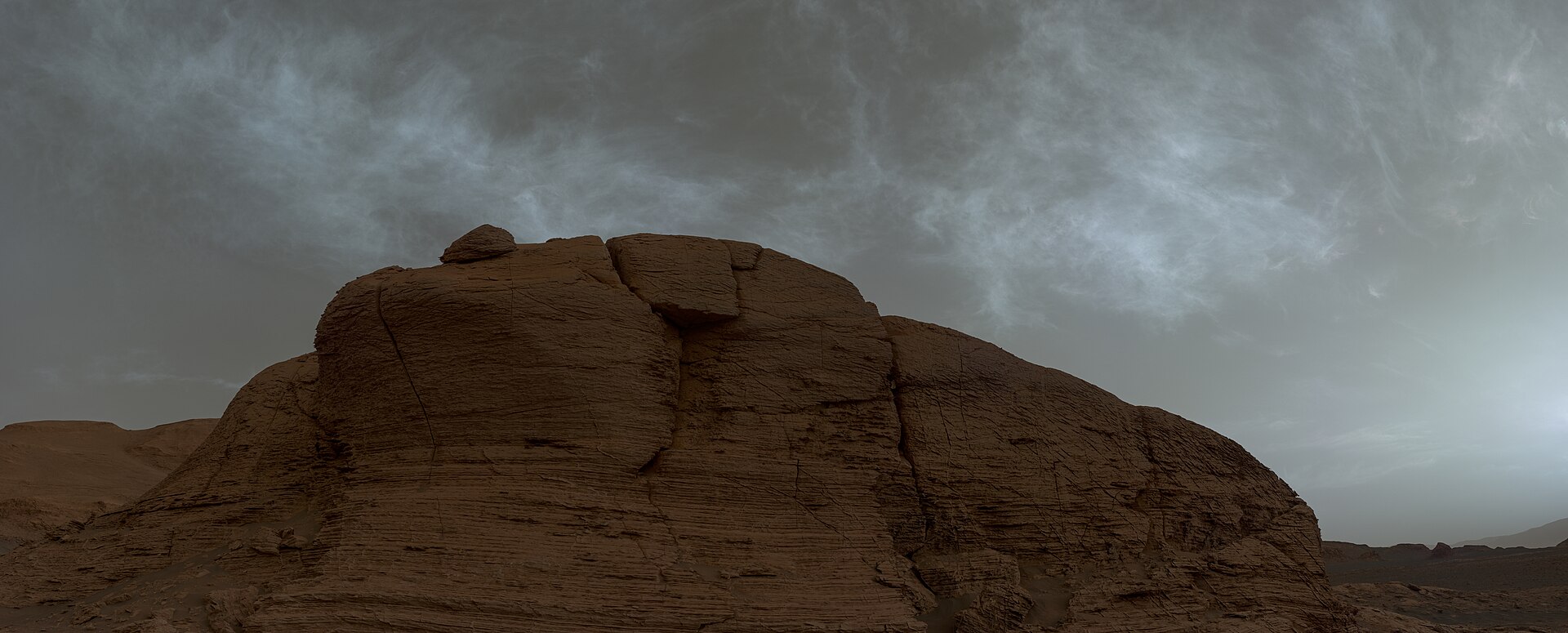
Before the rovers, Mars was a set of arguments about smudges. Telescopic observers saw features that some interpreted as canals and vegetation. Orbiters replaced that with geology — channels, volcanoes, layered terrain — but geology from orbit can only take you so far. To read the rock record, you have to get down and look closely at the rocks.
From proof of concept to field geology
The first successful rover was tiny, roughly the size of a microwave, and operated for weeks rather than years. Its scientific return was modest by later standards, but it demonstrated the essential thing: a mobile vehicle could survive landing, drive on Martian soil, and take measurements at targets chosen after arrival.
The generation that followed was larger, solar-powered, and built for a ninety-day nominal mission. Both dramatically outlasted that. One spent years crossing a plain and descending into craters; the other operated for well over a decade, long enough to walk the rim of a large crater and study rocks from a much older period of Martian history.
The current generation is nuclear-powered, car-sized, and equipped with laboratory instruments — drills, spectrometers that fire lasers at rock from a distance, and in one case a device for caching samples for eventual return to Earth.
What they found: water, repeatedly
The single largest shift in our understanding is that Mars was once wet, and not briefly.
The evidence is physical rather than inferential. Rovers have driven over rounded pebbles of the kind that only form when water tumbles them downstream. They have imaged cross-bedded sandstone laid down by flowing currents, and mudstones deposited in still water. They have found veins of calcium sulphate cutting through rock, precipitated by groundwater moving through fractures long after the sediments formed.
One rover found hematite spherules — nicknamed blueberries — that form in water-saturated rock. Another spent years climbing a mountain of layered sediment inside a crater, effectively reading upward through millions of years of environmental change recorded in the strata.
A crater floor that looked from orbit like flat dust turned out, at wheel level, to be the bed of an ancient lake.
Habitable, not inhabited
The distinction that has emerged is careful and important. Rovers have established that early Mars had environments that could have supported microbial life: liquid water at neutral pH, chemical energy gradients, and the necessary elements including carbon, hydrogen, nitrogen, oxygen, phosphorus, and sulphur.
Establishing habitability is not the same as detecting life. No rover has found unambiguous biosignatures, and the instruments carried so far are not really capable of settling the question. Organic molecules have been detected in Martian rock, which is significant, but organics can form without biology.
The methane puzzle
One of the more frustrating open threads is methane. Some measurements have detected low, seasonally varying concentrations in the atmosphere near the surface. Methane breaks down relatively quickly under Martian conditions, so its presence implies an active source — geological, biological, or something not yet identified.
Complicating matters, orbital measurements have struggled to confirm the surface detections at the levels reported. Reconciling the two remains unresolved.
Why samples need to come home
The consistent lesson across missions is that the most decisive analyses cannot be done on Mars. Rover instruments are miniaturised, power-limited, and fixed at launch. Terrestrial laboratories have room-sized equipment, can repeat measurements, can apply techniques invented after the sample was collected, and can be independently checked by other labs.
That is the reasoning behind sample caching: sealing carefully selected cores in tubes and leaving them for a future mission to retrieve. The return architecture is technically difficult and has been repeatedly reconsidered on cost grounds, but the scientific argument for it has not weakened.
What the rovers changed
The cumulative effect of three decades of surface exploration is that Mars stopped being a planet we speculate about and became a planet with a documented history. There were rivers. There were lakes. There was groundwater circulating through rock for extended periods. Something then changed — the loss of a magnetic field, the stripping of the atmosphere, the freezing out of surface water — and the planet we see now is the aftermath.
Understanding how a world that resembled early Earth became the cold desert it is today is worth the effort on its own, entirely apart from whether anything ever lived there.
Leave a Reply