Category: Space Missions

  • A Mission to an Ocean World: Exploring Europa From Orbit

    A Mission to an Ocean World: Exploring Europa From Orbit

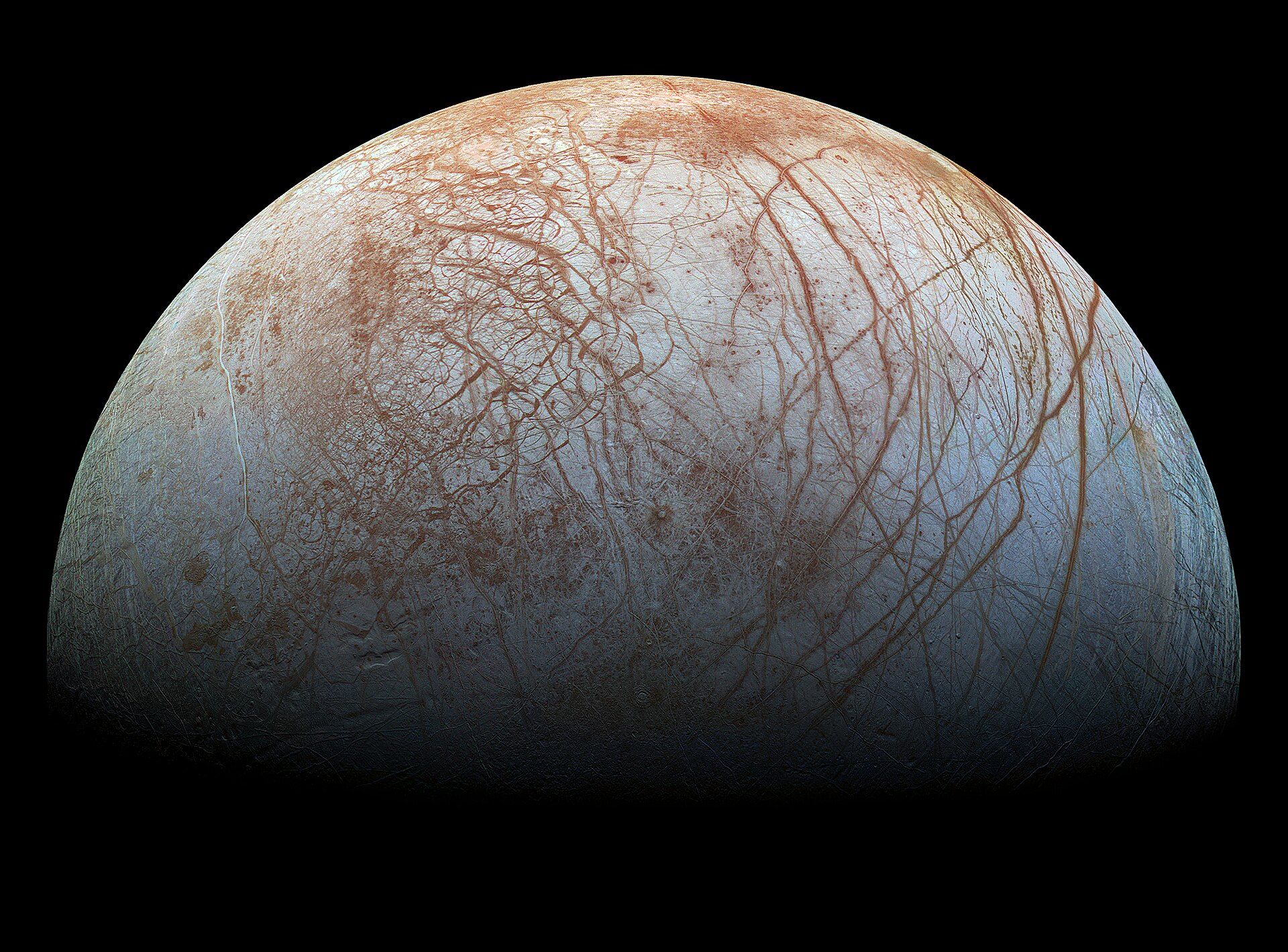
    Deciding whether Europa’s hidden ocean could support life requires more than orbital snapshots. It requires measuring the thickness of the ice, mapping the ocean beneath it, sampling whatever escapes to the surface, and doing all of it in one of the harshest radiation environments in the solar system.

    That is the job of Europa Clipper, the largest planetary spacecraft NASA has built.

    Orbiting Jupiter, not Europa

    The mission’s central design decision looks counterintuitive at first: the spacecraft will not orbit Europa. It will orbit Jupiter on a long, looping path, dipping past Europa for close flybys and then retreating.

    The reason is radiation. Jupiter’s magnetosphere accelerates charged particles to enormous energies, and Europa sits inside the worst of it. A spacecraft parked in Europa orbit would accumulate a lethal dose to its electronics in a matter of weeks. By spending most of each orbit far from Jupiter and only sprinting through the danger zone, Clipper can accumulate dozens of close passes over years rather than dying after a few.

    Even so, the most sensitive electronics are housed in a thick-walled vault of titanium and aluminium — essentially a radiation-shielded safe at the heart of the spacecraft.

    What it carries

    The instrument suite is built to answer three questions: how thick is the ice, what is the ocean like, and what is the surface made of.

    • An ice-penetrating radar designed to profile the shell and look for water pockets within it, or the boundary at its base.
    • A magnetometer to refine the induced-field measurements that first indicated a conductive ocean, tightening the constraints on its depth and salinity.
    • Mass spectrometers to sample gas and dust around the moon, including any material lofted from plumes or knocked off the surface by micrometeorites.
    • Cameras and spectrometers covering visible, ultraviolet, and infrared wavelengths to map composition and geology at high resolution.
    • A thermal imager to hunt for warm spots that might mark recent activity or thin ice.

    Notably, several of these instruments can sample Europa’s material without landing. If plumes vent from the subsurface, flying through one turns a flyby into a sampling mission.

    The spacecraft’s solar arrays span more than thirty metres — necessary because sunlight at Jupiter is roughly one twenty-fifth as strong as at Earth.

    Getting there

    Jupiter is a long way, and a direct transfer is expensive in fuel. Clipper takes an indirect route, using gravity assists to build up speed over several years before arrival. Once in the Jovian system, the orbit is gradually reshaped by repeated encounters, bringing the spacecraft over different parts of Europa on each pass so the coverage accumulates into a global map.

    The plan calls for roughly fifty close flybys, some passing within a few tens of kilometres of the surface.

    Not travelling alone

    Europa Clipper shares the Jupiter system with the European Space Agency’s JUICE mission, which launched earlier and is focused primarily on Ganymede, with flybys of Callisto and Europa along the way. Ganymede is the only moon known to generate its own internal magnetic field, and it is thought to hold a deep ocean of its own.

    Two spacecraft studying the same system with complementary instruments is a substantial upgrade over anything since Galileo, the orbiter that first made the case for Europa’s ocean in the 1990s.

    What it will not do

    It is worth being precise about the mission’s limits. Europa Clipper is not a life-detection mission. It carries no instrument capable of confirming biology, and it will not land, drill, or reach the ocean.

    Its purpose is habitability assessment: determining whether the environment has the ingredients life requires. That distinction matters, because the results will shape what gets built next. If the ice turns out to be thin in places, or plumes are confirmed as a reliable sampling route, the case for a lander becomes far stronger — and far better targeted.

    The reconnaissance has to come first.

  • The Voyager Probes: Humanity’s Farthest Travelers

    The Voyager Probes: Humanity’s Farthest Travelers

    In the summer of 1977, two spacecraft left Earth within sixteen days of each other. They were built with the computing power of a pocket calculator, designed for a four-year mission to Jupiter and Saturn, and expected to fall silent long before the century ended.

    They are still transmitting.

    The alignment that made it possible

    The Voyager missions exist because of an accident of orbital mechanics. Once every 176 years, the outer planets line up in an arrangement that allows a single spacecraft to visit several of them in sequence, using each planet’s gravity to slingshot on to the next.

    That alignment was available in the late 1970s. Missing it meant waiting nearly two centuries. The gravity-assist technique — stealing a tiny amount of a planet’s orbital momentum to accelerate a spacecraft — made a tour possible that no rocket of the era could have achieved on propulsion alone.

    Voyager 2 launched first, on the slower path that would take it past all four giant planets. Voyager 1 launched second on a faster trajectory, reached Jupiter earlier, and then took a route past Saturn’s moon Titan that flung it up and out of the plane of the solar system.

    What they found

    The scientific return reshaped planetary science, largely because nearly everything was a surprise.

    At Jupiter, the moons turned out to be worlds rather than points of light. Io was found to be volcanically active — the first active volcanism discovered beyond Earth, driven by tidal heating. Europa showed a young, cracked, nearly crater-free ice surface, the first hint of the ocean now thought to lie beneath it. Jupiter turned out to have a faint ring system nobody had predicted.

    At Saturn, the rings resolved into thousands of distinct ringlets with braided and kinked structures that took years to explain. Titan proved to have a thick nitrogen atmosphere, opaque at visible wavelengths, hiding a surface that would not be seen properly for another quarter century.

    Voyager 2 alone continued to Uranus and Neptune, and remains the only spacecraft to have visited either. It found Uranus tipped on its side with a bizarrely offset magnetic field, and at Neptune discovered supersonic winds and a moon, Triton, with active nitrogen geysers erupting from a surface at around 38 kelvin.

    Two spacecraft, one launch window, and the only close-up data humanity has ever collected on two of the eight planets.

    Into interstellar space

    After the planetary encounters, both spacecraft kept going. The mission became a study of the heliosphere — the vast bubble of charged particles blown outward by the Sun.

    Voyager 1 crossed the heliopause, the boundary where the solar wind gives way to the interstellar medium, in 2012. Voyager 2 followed in 2018 on a different trajectory. The crossings were identified not by any dramatic marker but by a sharp change in the density of charged particles and the direction of the magnetic field.

    They are the only spacecraft to have made in-situ measurements of interstellar space, and they found it different from predictions in ways that are still being worked through.

    Keeping them alive

    Both spacecraft are powered by radioisotope thermoelectric generators, which convert heat from decaying plutonium into electricity. The output declines by a few watts every year, and it has been declining for nearly five decades.

    Mission operations has become an exercise in careful triage. Instruments have been switched off one at a time. Heaters have been sacrificed, in some cases leaving components operating well below their rated temperatures — and working anyway. Engineers have swapped to backup thruster sets and rewritten commands for computers whose original programmers have retired.

    The communication challenge is equally severe. Signals take more than twenty hours each way, and arrive with a power measured in fractions of a billionth of a watt, requiring the largest dish antennas on Earth to detect at all.

    Sometime in the 2030s the power budget will fall below what even a single instrument requires, and both spacecraft will go quiet. They will keep travelling regardless, on trajectories that will carry them past other stars in tens of thousands of years.

    The record

    Each Voyager carries a gold-plated copper phonograph record holding sounds and images selected to represent Earth: greetings in dozens of languages, music from many cultures, whale song, thunder, a heartbeat.

    The odds of any of it ever being found are effectively zero, and the people who assembled it knew that. It was never really addressed outward. It is a statement about what a species thought was worth saying about itself, launched at a moment when it had just learned how to leave.

  • The Search for Life: Inside Astrobiology’s Biggest Questions

    The Search for Life: Inside Astrobiology’s Biggest Questions

    Astrobiology has an awkward founding problem: it is a scientific field studying a subject with no confirmed examples beyond a single case. Every organism ever examined descends from a common ancestor on one planet.

    That does not make the field unserious. It makes it unusually careful about definitions.

    The questions underneath the question

    “Are we alone” decomposes into several distinct problems, and conflating them causes most of the confusion in public discussion.

    • How does non-living chemistry become living chemistry? This is the origin-of-life problem, and it is a question about Earth as much as anywhere else.
    • Given a habitable environment, how likely is life to arise? Unknown, and the single data point we have does not constrain it.
    • Given microbial life, how likely is complex multicellular life? On Earth this took billions of years, which may or may not mean it is difficult.
    • Given complex life, how likely is technology? An entirely separate question, and the one SETI addresses.

    Confirming microbial life on Mars would be one of the most significant discoveries in history and would say almost nothing about the fourth question.

    What counts as habitable

    The working definition centres on liquid water, an energy source, and the elements life needs — carbon, hydrogen, nitrogen, oxygen, phosphorus, sulphur.

    Liquid water gets the emphasis because it is an unusually good solvent, remains liquid across a wide temperature range, and participates directly in biochemistry. This may be parochial, but it is the only chemistry with a demonstrated track record.

    The classical habitable zone is the orbital band around a star where a planet with an Earth-like atmosphere could sustain surface liquid water. It is a useful screening tool and a poor final criterion, because it ignores atmospheric composition, and because it says nothing about subsurface oceans.

    That last point has reshaped the field. Europa, Enceladus, Titan, Ganymede, and possibly others hold liquid water far outside any star’s habitable zone, kept warm by tidal heating rather than sunlight. If subsurface oceans are the most common habitable environment in the universe, then habitable-zone statistics are measuring the wrong thing.

    What Earth’s extremophiles taught us

    The expansion of the habitability concept came largely from discovering how much of Earth is inhabited.

    Microbes thrive in near-boiling hydrothermal vents, in brine at temperatures well below freezing, in highly acidic mine drainage, under crushing pressure in ocean trenches, in rock kilometres below the surface, and in radiation fields that would sterilise most laboratory equipment.

    Deep-sea vent ecosystems were particularly consequential because they run on chemical energy rather than sunlight. Before their discovery, photosynthesis seemed a near-prerequisite for a substantial biosphere. It is not.

    Every time the known limits of life on Earth were tested, they turned out to be wider than assumed.

    How you would actually detect it

    Three broad strategies are in play, with different timescales and different failure modes.

    Look for it in the solar system

    Send instruments to Mars, to the plumes of Enceladus, to Europa, to Titan. The advantage is direct access to material. The difficulty is that detecting life is genuinely hard even with a sample in hand — distinguishing biological signatures from abiotic chemistry has tripped up serious researchers before, including in the ambiguous results of the Viking landers in the 1970s.

    Planetary protection is a real constraint here. Spacecraft are sterilised to avoid the outcome where the life detected turns out to have arrived on the probe.

    Look for atmospheric biosignatures

    An atmosphere far from chemical equilibrium suggests something is continuously replenishing it. Earth’s simultaneous oxygen and methane would be difficult to explain without biology.

    Transit spectroscopy can now measure exoplanet atmospheric composition, though for small rocky planets the signals sit at the edge of what current instruments can achieve. The interpretive problem is severe: for nearly every proposed biosignature, someone has since identified an abiotic pathway that could produce it.

    Look for technology

    SETI searches for signals — narrowband radio transmissions, optical pulses — that no natural process is known to produce. It is inexpensive relative to spacecraft and can cover enormous volumes of space, but it assumes a technological civilisation transmitting detectably during the window we happen to be listening.

    The uncomfortable silence

    The Fermi paradox is the observation that the galaxy is old, contains hundreds of billions of stars, and shows no obvious sign of anyone. Proposed resolutions range from life being rare, to intelligence being rare, to civilisations being short-lived, to our searches having covered a negligible fraction of the relevant parameter space.

    The last explanation is the most defensible and the least satisfying. The volume of signal types, frequencies, and directions searched so far is small compared to the space of possibilities.

    Astrobiology’s honest position is that we do not know, that the question is now approachable with real instruments rather than speculation alone, and that the most likely first discovery is microbial, ambiguous, and argued over for a decade.

  • Watching Our Star: The Missions That Study the Sun

    Watching Our Star: The Missions That Study the Sun

    The Sun is the only star close enough to study in detail, and it is the one that most directly affects us. It is also, in several respects, poorly understood — with a couple of longstanding problems that have resisted explanation for decades.

    A fleet of spacecraft is now watching it continuously, from several vantage points at once.

    Why constant monitoring

    The Sun is not a steady lamp. Its magnetic field is generated by the churning motion of ionised gas in its interior, and it reverses polarity on a roughly eleven-year cycle. Activity — sunspots, flares, eruptions — rises and falls with it.

    The consequences reach Earth. Solar flares release radiation that arrives in eight minutes and can disrupt radio communication and navigation. Coronal mass ejections launch billions of tonnes of magnetised plasma that take one to three days to arrive and can induce currents in power grids, damage satellites, and pose radiation risks to astronauts.

    Modern infrastructure is far more sensitive to this than infrastructure was a century ago. The largest recorded geomagnetic storm, in 1859, mainly affected telegraph systems. An equivalent event now would be considerably more disruptive, which is why space weather forecasting has become an operational service rather than a research curiosity.

    The layers being studied

    Understanding the observations requires knowing what part of the Sun each instrument targets.

    • The core, where fusion converts hydrogen to helium, releasing the energy that powers everything else.
    • The radiative and convective zones, through which that energy slowly works outward — a journey that takes photons on the order of a hundred thousand years.
    • The photosphere, the visible surface, at around 5,500 degrees Celsius. This is where sunspots appear as cooler regions where strong magnetic fields suppress convection.
    • The chromosphere, a thin layer above it.
    • The corona, the outer atmosphere, visible during total eclipses as a pearly halo.

    The corona is over a million degrees. The surface below it is around 5,500. Heat flowing from cooler to hotter is exactly backwards, and explaining it is one of solar physics’ central open problems.

    The coronal heating problem has candidate explanations — dissipation of magnetic waves, or vast numbers of small reconnection events called nanoflares — but no settled answer. Distinguishing between them requires measurements from inside the corona itself.

    The current fleet

    Several missions approach the problem from complementary angles.

    A spacecraft in a highly elliptical orbit has flown repeatedly through the outer corona, closer to the Sun than anything before it, protected by a carbon composite heat shield. Flying inside the region where the solar wind is accelerated allows direct sampling of plasma and magnetic fields rather than inference from a distance.

    Another mission, a European-led collaboration, combines remote sensing with in-situ measurement and has used Venus gravity assists to raise its orbital inclination — giving humanity its first views of the Sun’s polar regions, which are important because the polar magnetic field is central to the solar dynamo.

    An observatory in geosynchronous orbit has provided continuous high-resolution imaging of the full solar disk across multiple wavelengths for over a decade, producing a data set of remarkable consistency for tracking how active regions develop.

    Older spacecraft continue operating, including a long-serving observatory at the L1 point between Earth and the Sun, and a pair of probes placed in orbits ahead of and behind Earth to allow stereoscopic views.

    On the ground, a new generation of solar telescopes resolves features on the photosphere at scales of a few tens of kilometres, revealing convection cells and magnetic structure in unprecedented detail.

    What has come out of it

    Close-in observations have found magnetic field reversals in the solar wind — sharp S-shaped kinks nicknamed switchbacks — that were not anticipated and are still being interpreted. They may be connected to the process that accelerates the wind in the first place.

    The first images of the solar poles have begun to constrain dynamo models that previously relied on extrapolation.

    Continuous full-disk monitoring has substantially improved the ability to identify active regions likely to produce eruptions, though flare prediction remains probabilistic rather than deterministic.

    The forecasting gap

    Space weather prediction is roughly where terrestrial weather forecasting was several decades ago: useful, improving, and frequently wrong about specifics.

    The fundamental limitation is warning time. A coronal mass ejection’s effect on Earth depends heavily on the orientation of its magnetic field, and that is not reliably measurable until the cloud passes a spacecraft at the L1 point — about a million and a half kilometres upstream, which translates to something like thirty to sixty minutes of notice.

    Extending that lead time is a significant motivation for missions that would monitor the Sun from off the Sun-Earth line, viewing eruptions from the side rather than head-on. For grid operators, the difference between thirty minutes and several hours is the difference between reacting and preparing.