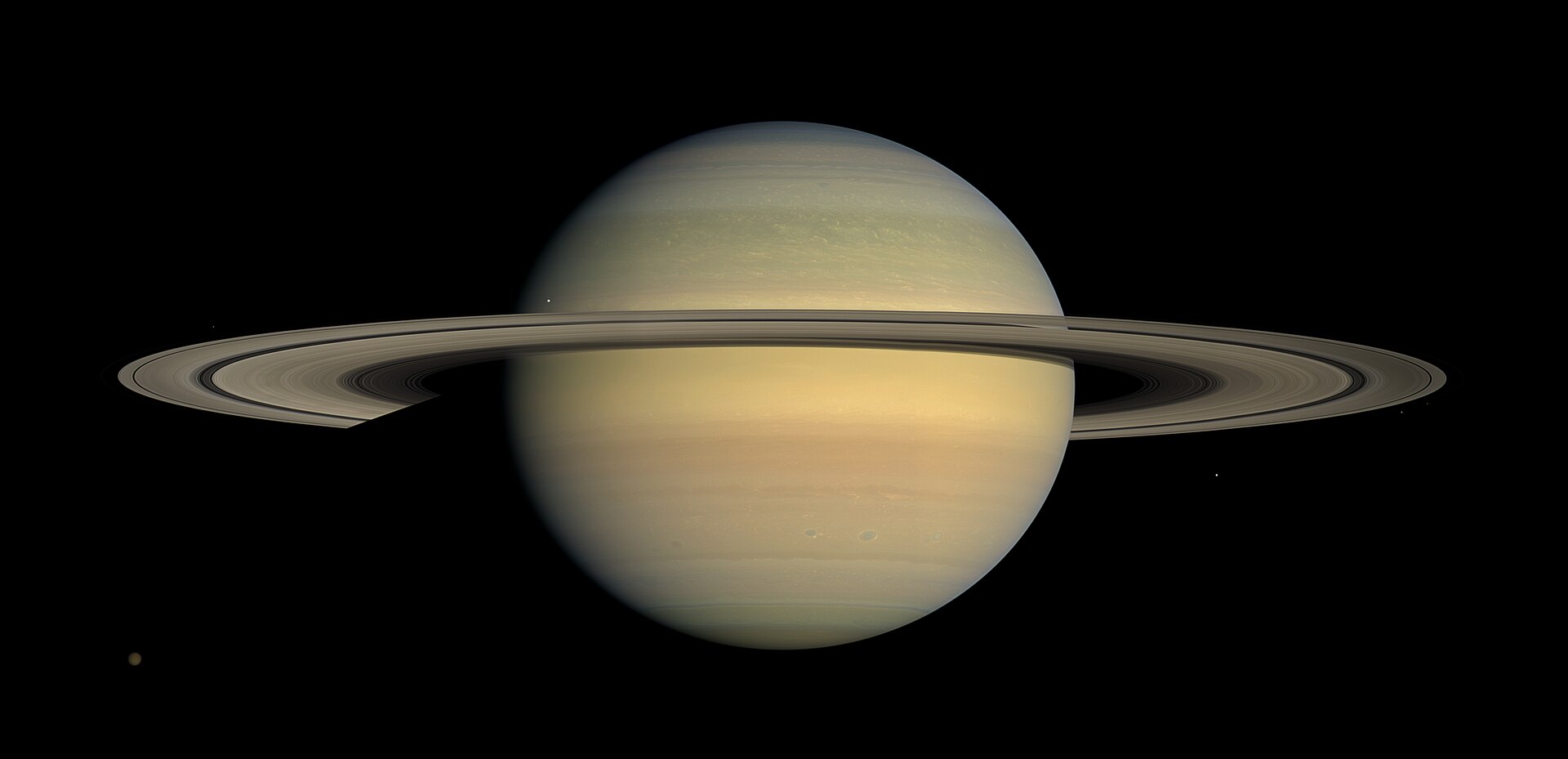
Saturn is not the only planet with rings. Jupiter, Uranus, and Neptune all have them. What makes Saturn’s exceptional is that they are bright, wide, and visible in a small telescope from a back garden — a planetary feature you can confirm with your own eyes in about ten seconds.
They are also, on cosmic timescales, probably temporary.
What they are made of
The rings are not solid. They are composed of countless individual particles, each on its own orbit around Saturn, ranging from grains of dust to chunks the size of a house.
The composition is remarkably pure: over ninety percent water ice, with only a small fraction of rocky contamination. That purity is one of the strongest arguments that the rings are young. The solar system is full of micrometeoroid dust, and any ring system exposed to it for billions of years should have accumulated visible darkening. Saturn’s rings are conspicuously clean.
They are also extraordinarily thin. The main ring system spans roughly 280,000 kilometres across, but its vertical thickness is typically measured in tens of metres. Scaled to the diameter of a sheet of paper, the rings would be thousands of times thinner than the paper itself. This is why they disappear entirely when Earth passes through the ring plane and we view them edge-on.
Why they are rings and not a moon
Any material orbiting close to a large planet faces a competition. Its own gravity tries to pull it together into a single body; the planet’s tidal forces try to pull it apart.
Inside a boundary called the Roche limit, tides win, and material cannot coalesce. Saturn’s main rings lie inside that limit — which is why they remain a disk of separate particles rather than clumping into a moon.
The structure within the disk comes from moons. Gaps such as the Cassini Division are cleared by orbital resonances with moons further out: particles at certain distances receive a repeated gravitational nudge on every orbit, and are gradually pushed elsewhere. Small shepherd moons orbit within and beside narrow rings, confining their edges. Others create waves and vertical corrugations that propagate across the disk.
The rings are less a static feature than an ongoing gravitational conversation between Saturn and its moons.
The age problem
For most of the twentieth century, the assumption was that the rings formed alongside Saturn roughly four and a half billion years ago. Several lines of evidence now point the other way.
The purity of the ice, as noted, suggests limited exposure time. More decisively, measurements made during a spacecraft’s final orbits between the planet and the innermost ring allowed the total mass of the ring system to be determined directly for the first time — and it turned out to be relatively low, roughly comparable to one of Saturn’s mid-sized icy moons.
A low-mass ring system is easier to erode and harder to sustain. Combined with the estimated rate at which material is contaminated and lost, the numbers point toward an age in the range of tens to a few hundred million years. That would mean the rings formed while dinosaurs walked on Earth, and that for most of Saturn’s history it looked considerably less impressive.
The obvious follow-up question — what happened a hundred million years ago to create them — does not have a settled answer. A moon that wandered inside the Roche limit and was torn apart is the leading category of explanation.
Ring rain
The rings are also disappearing, and the mechanism has been measured.
Ice particles in the rings become charged, either by ultraviolet sunlight or by plasma in Saturn’s magnetosphere. Once charged, they are captured by the planet’s magnetic field and channelled down into the upper atmosphere, where they fall as a steady drizzle of water.
Measurements of this ring rain suggest losses substantial enough to drain the rings entirely within roughly a hundred million years — possibly considerably less. The number carries real uncertainty, and estimates have shifted as the data improved, but the direction is not in dispute.
A matter of timing
The combination is striking. If the rings are only a hundred million years old and have another hundred million years left, then the entire span during which Saturn possesses spectacular rings is a narrow window in a four-and-a-half-billion-year history — and we happen to be alive inside it.
That is not evidence of anything cosmically special about the present moment. It is a reminder that the solar system is not a finished, static arrangement. It is a system still in motion, and some of its most familiar features are passing phases we caught mid-sentence.
Leave a Reply