Tag: Planets

  • The Night Sky This Season: Planets and Phases to Watch

    The Night Sky This Season: Planets and Phases to Watch

    Naked-eye astronomy is underrated. Most people’s first instinct is that seeing anything interesting requires equipment, and then the equipment sits unused in a cupboard. The truth is that the sky offers a rotating programme of things worth looking at, and knowing what is up tonight is most of the skill.

    Here is a framework for observing any season, rather than a list that goes stale in a fortnight.

    Start with the planets

    Five planets are visible without any optical aid, and they are the easiest wins available.

    • Venus is unmistakable — the brightest thing in the sky after the Sun and Moon, appearing either in the west after sunset or the east before sunrise, never far from the Sun.
    • Jupiter is the next brightest, holds steady, and rewards even modest binoculars by showing its four largest moons as a line of pinpricks that shifts night to night.
    • Mars varies enormously. Near opposition it is a striking orange beacon; at other times it is unremarkable.
    • Saturn is a steady yellowish point to the eye. Any small telescope shows the rings, which is the single most reliable way to convert a sceptic.
    • Mercury is the difficult one, always low and lost in twilight, visible only during brief windows near its greatest elongations.

    The reliable way to tell a planet from a star is that stars twinkle and planets generally do not. Stars are point sources, so atmospheric turbulence makes them flicker; planets present a tiny disk, which averages the turbulence out.

    Let the Moon set your schedule

    The Moon is both the best target for beginners and the biggest obstacle to everything else, so it is worth planning around rather than ignoring.

    For lunar observing, avoid full Moon. It sounds backwards, but a full Moon is lit straight-on, which flattens all the shadows and washes out detail. The rewarding views are along the terminator — the line dividing day from night — where low-angle sunlight throws crater rims and mountain ranges into sharp relief. A first-quarter or last-quarter Moon shows dramatically more texture than a full one.

    For everything else — galaxies, nebulae, meteor showers, the Milky Way — you want the Moon out of the sky entirely. The week around new Moon is the dark-sky window.

    Two roughly week-long windows each month: one for the Moon, one for everything else.

    The seasonal headliners

    Earth’s orbit means we face a different part of the galaxy at different times of year, and the character of the sky changes with it.

    Northern-hemisphere winter evenings look outward, away from the galactic centre, toward the nearby star-forming regions in Orion. This is the brightest, most easily recognised stretch of sky, with the Orion Nebula visible to the naked eye as a fuzzy patch in the sword.

    Spring evenings look up out of the galactic plane, so there are fewer bright stars but a clear view into intergalactic space — the direction of the great galaxy clusters, though these need a telescope.

    Summer evenings face the galactic centre. The Milky Way is at its densest and brightest, threading through Sagittarius and Scorpius, dense with star clusters and nebulae. From a dark site this is the best sky of the year.

    Autumn brings the Andromeda Galaxy high overhead, the most distant object routinely visible to the unaided eye at roughly two and a half million light years.

    Practical habits

    A few things make the difference between a pleasant hour and a frustrating one.

    Give your eyes twenty to thirty minutes to adapt, and protect that adaptation ruthlessly. One glance at a phone screen resets it.

    Learn to use averted vision. Look slightly to the side of a faint object rather than directly at it; the periphery of the retina is far more sensitive in low light, and faint galaxies often pop into view when you stop staring at them.

    Check the transparency, not just the cloud cover. A haze-free night with steady air shows far more than a technically clear but humid one.

    And use a planetarium app to plan before you go out, then put the phone away once you are outside.
  • Saturn’s Rings: What They Are and How Long They Will Last

    Saturn’s Rings: What They Are and How Long They Will Last

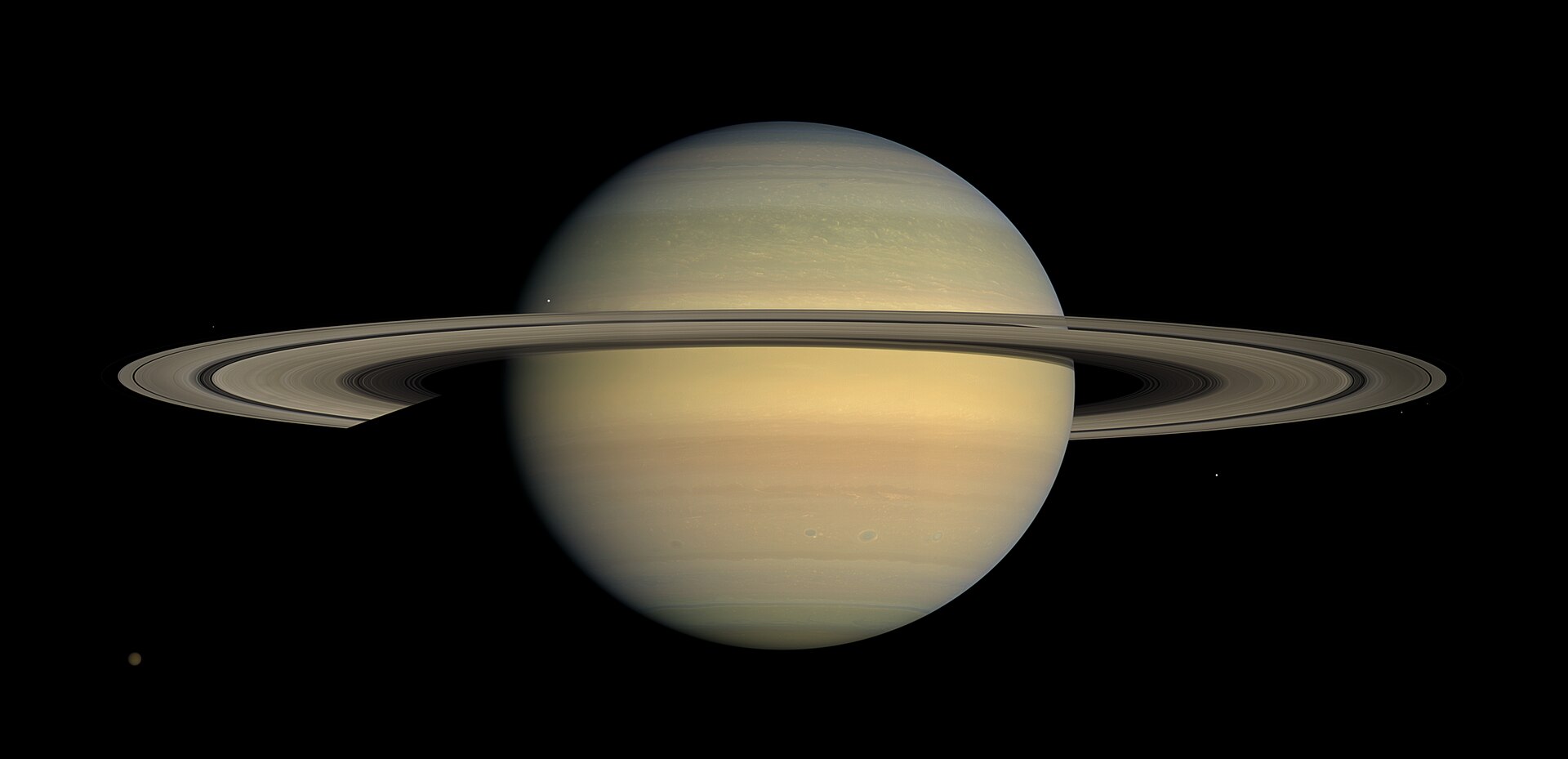
    Saturn is not the only planet with rings. Jupiter, Uranus, and Neptune all have them. What makes Saturn’s exceptional is that they are bright, wide, and visible in a small telescope from a back garden — a planetary feature you can confirm with your own eyes in about ten seconds.

    They are also, on cosmic timescales, probably temporary.

    What they are made of

    The rings are not solid. They are composed of countless individual particles, each on its own orbit around Saturn, ranging from grains of dust to chunks the size of a house.

    The composition is remarkably pure: over ninety percent water ice, with only a small fraction of rocky contamination. That purity is one of the strongest arguments that the rings are young. The solar system is full of micrometeoroid dust, and any ring system exposed to it for billions of years should have accumulated visible darkening. Saturn’s rings are conspicuously clean.

    They are also extraordinarily thin. The main ring system spans roughly 280,000 kilometres across, but its vertical thickness is typically measured in tens of metres. Scaled to the diameter of a sheet of paper, the rings would be thousands of times thinner than the paper itself. This is why they disappear entirely when Earth passes through the ring plane and we view them edge-on.

    Why they are rings and not a moon

    Any material orbiting close to a large planet faces a competition. Its own gravity tries to pull it together into a single body; the planet’s tidal forces try to pull it apart.

    Inside a boundary called the Roche limit, tides win, and material cannot coalesce. Saturn’s main rings lie inside that limit — which is why they remain a disk of separate particles rather than clumping into a moon.

    The structure within the disk comes from moons. Gaps such as the Cassini Division are cleared by orbital resonances with moons further out: particles at certain distances receive a repeated gravitational nudge on every orbit, and are gradually pushed elsewhere. Small shepherd moons orbit within and beside narrow rings, confining their edges. Others create waves and vertical corrugations that propagate across the disk.

    The rings are less a static feature than an ongoing gravitational conversation between Saturn and its moons.

    The age problem

    For most of the twentieth century, the assumption was that the rings formed alongside Saturn roughly four and a half billion years ago. Several lines of evidence now point the other way.

    The purity of the ice, as noted, suggests limited exposure time. More decisively, measurements made during a spacecraft’s final orbits between the planet and the innermost ring allowed the total mass of the ring system to be determined directly for the first time — and it turned out to be relatively low, roughly comparable to one of Saturn’s mid-sized icy moons.

    A low-mass ring system is easier to erode and harder to sustain. Combined with the estimated rate at which material is contaminated and lost, the numbers point toward an age in the range of tens to a few hundred million years. That would mean the rings formed while dinosaurs walked on Earth, and that for most of Saturn’s history it looked considerably less impressive.

    The obvious follow-up question — what happened a hundred million years ago to create them — does not have a settled answer. A moon that wandered inside the Roche limit and was torn apart is the leading category of explanation.

    Ring rain

    The rings are also disappearing, and the mechanism has been measured.

    Ice particles in the rings become charged, either by ultraviolet sunlight or by plasma in Saturn’s magnetosphere. Once charged, they are captured by the planet’s magnetic field and channelled down into the upper atmosphere, where they fall as a steady drizzle of water.

    Measurements of this ring rain suggest losses substantial enough to drain the rings entirely within roughly a hundred million years — possibly considerably less. The number carries real uncertainty, and estimates have shifted as the data improved, but the direction is not in dispute.

    A matter of timing

    The combination is striking. If the rings are only a hundred million years old and have another hundred million years left, then the entire span during which Saturn possesses spectacular rings is a narrow window in a four-and-a-half-billion-year history — and we happen to be alive inside it.

    That is not evidence of anything cosmically special about the present moment. It is a reminder that the solar system is not a finished, static arrangement. It is a system still in motion, and some of its most familiar features are passing phases we caught mid-sentence.