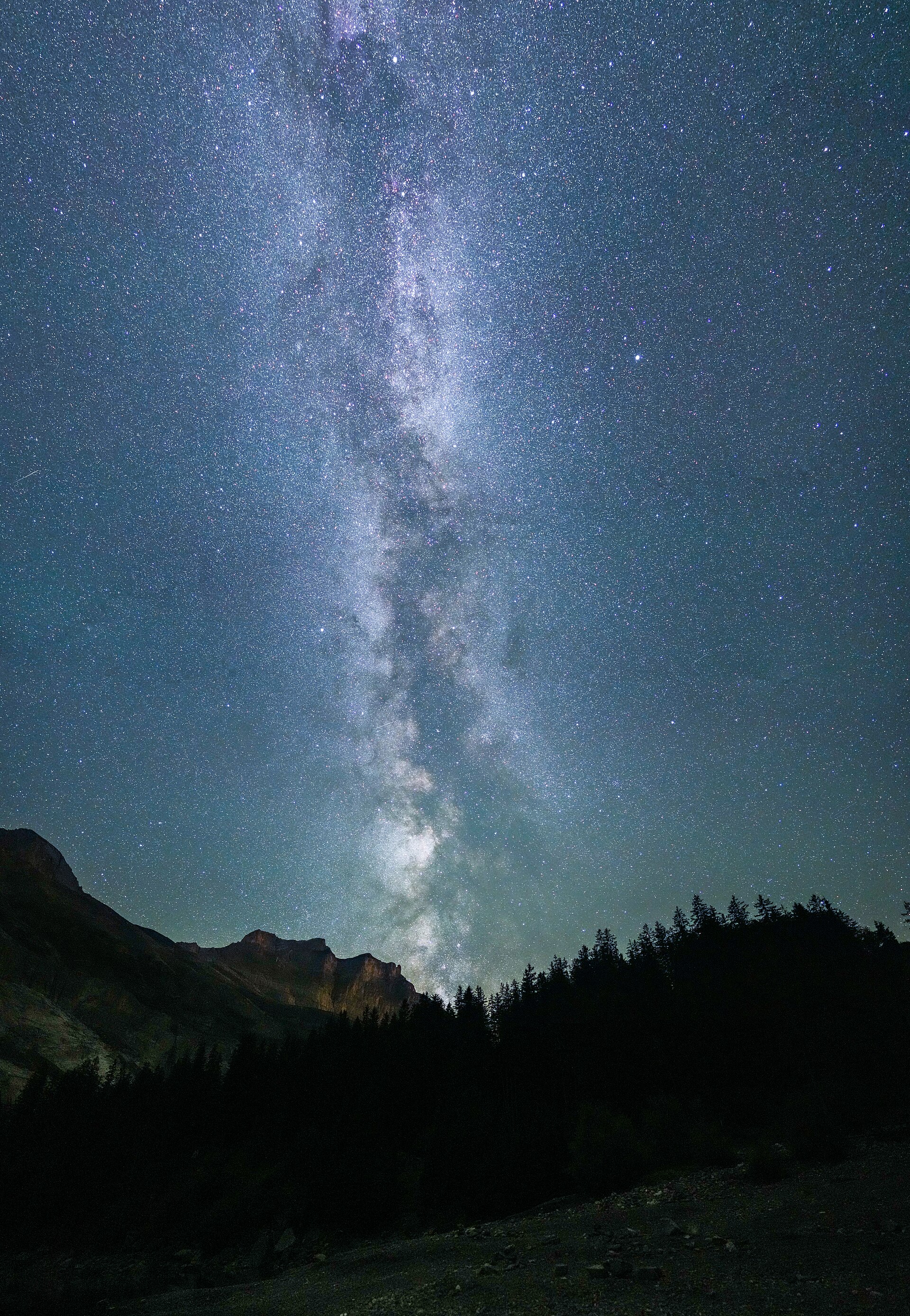
For most of human history, the Milky Way was an unremarkable fact of life — a band of light overhead that every culture built stories around. It is now invisible to the majority of people on Earth. Roughly a third of humanity, and around eighty percent of people in North America and Europe, live under skies too bright to see it at all.
The cause is not pollution in the usual sense. It is light that was generated deliberately and then aimed, scattered, or wasted where nobody needed it.
What light pollution actually is
The term covers several distinct problems, and they are worth separating because they have different fixes.
- Skyglow is the diffuse orange or grey dome over populated areas, caused by artificial light scattering off molecules and aerosols in the atmosphere. This is what erases the stars.
- Glare is excessive brightness that reduces contrast and impairs vision, often making a scene less visible rather than more.
- Light trespass is light falling where it is not wanted — a neighbour’s floodlight through a bedroom window.
- Clutter is the confusing excess of bright, competing sources common in commercial areas.
Skyglow travels. A city can noticeably brighten the sky a hundred kilometres away, which is why genuinely dark sites are increasingly hard to reach from most population centres.
How it is measured
Astronomers use the Bortle scale, a nine-point classification running from Class 1 — an exceptionally dark site where the Milky Way casts visible shadows and the zodiacal light is obvious — to Class 9, an inner-city sky where only the Moon, planets, and a handful of the brightest stars are visible.
A useful rule of thumb is the number of stars visible to the naked eye. Under a truly dark sky, that number is a few thousand. In a suburban sky it may be a few hundred. In a city centre it can drop into the dozens.
Another practical test is whether the Milky Way is visible at all. If it is not, you are already losing most of what the sky has to offer.
Under a Class 1 sky, the Milky Way is bright enough to be mistaken for cloud. Most people have never seen this.
It is not only an astronomy problem
The case against light pollution does not rest on stargazing alone.
Nocturnal animals — which is most animal species — evolved under natural light cycles, and artificial light disrupts them measurably. Migrating birds are drawn off course by illuminated buildings, sometimes fatally. Sea turtle hatchlings navigate toward the brightest horizon, which used to be the ocean and is now often a car park. Insect populations are drawn to lights and die there in numbers that matter for pollination and food webs.
Human circadian rhythms respond to light exposure, particularly at the blue end of the spectrum, and there is a substantial body of research on the effects of nighttime light on sleep.
And there is the straightforward economic point: light directed upward into the sky is energy paid for and thrown away.
The LED complication
The transition to LED street lighting was, on paper, an environmental improvement — dramatically more efficient, longer-lived, and easier to control.
In practice the early rollouts often made skyglow worse. Two reasons: many first-generation installations used high colour temperatures rich in blue light, which scatters far more efficiently in the atmosphere than warmer wavelengths. And because LEDs are cheap to run, the efficiency gains were frequently spent on more light rather than lower bills — a rebound effect familiar from other efficiency transitions.
The fix is well understood. Warmer colour temperatures, full-cutoff fixtures that direct light downward, dimming or switching off during hours of low use, and lighting levels matched to actual need. LEDs are more controllable than what they replaced; the technology was never the problem.
Finding a dark sky
The practical question for an observer is where to go.
Light pollution atlases are freely available online and show skyglow mapped globally, which is the fastest way to identify promising directions from where you live. Certified dark-sky places — parks, reserves, and communities that have adopted lighting standards — are a good starting point and are usually set up for visitors.
A few practical notes. Elevation helps, since getting above haze and low-level moisture improves transparency considerably. Distance from a city matters more than absolute remoteness, and direction matters too: a site fifty kilometres from a city has a bright horizon in one direction and a dark one in the other, so plan what you want to observe accordingly.
Time it near new Moon, check that the site is legally accessible after dark, and tell someone where you are going.
The first time you see the Milky Way properly is memorable in a way that is hard to convey secondhand. It is not a faint smudge. It has structure, dust lanes, and enough brightness to be startling.
Leave a Reply