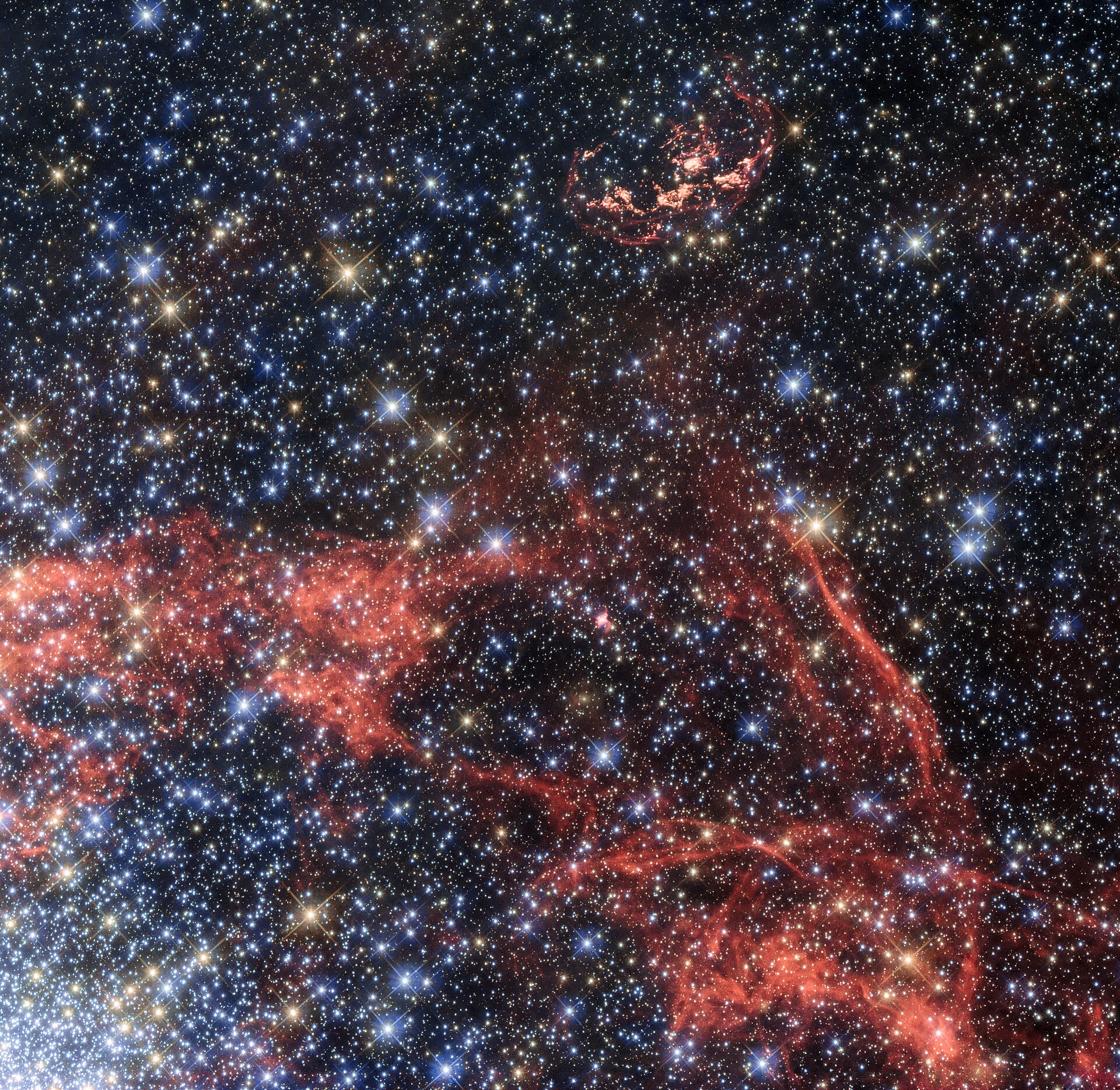
When a massive star runs out of fuel, its core collapses. If the remnant is heavy enough, nothing stops the collapse and a black hole forms. If it sits in a particular range — very roughly between one and a half and two and a half solar masses — the collapse halts at a state that is arguably stranger than a black hole, because unlike a black hole, you can actually observe its surface.
What stops the collapse
As the core implodes, electrons are forced into protons, converting them into neutrons and releasing a flood of neutrinos. What remains is a sphere composed almost entirely of neutrons, packed to nuclear density.
The collapse is arrested by neutron degeneracy pressure — a quantum mechanical effect arising from the exclusion principle, which forbids identical particles from occupying the same quantum state. This is not a thermal pressure and does not depend on temperature. It is a consequence of quantum statistics, and it holds up an object with the mass of a star.
The numbers are difficult to internalise. A typical neutron star packs one to two solar masses into a sphere roughly twenty kilometres across — the size of a city. A teaspoon of the material would weigh about as much as a mountain. Surface gravity is on the order of a hundred billion times Earth’s.
A neutron star is what happens when an object the mass of the Sun is compressed until it is essentially one enormous atomic nucleus.
Spin and magnetism
Two properties are amplified dramatically by the collapse.
Angular momentum is conserved, so as the core shrinks by a factor of tens of thousands in radius, its rotation rate increases enormously. Newly formed neutron stars can rotate many times per second. The fastest known — spun up by accreting material from a companion — complete over 700 rotations per second, meaning the surface is moving at a substantial fraction of the speed of light.
Magnetic flux is similarly concentrated. Neutron star magnetic fields are typically a trillion times stronger than Earth’s. A subclass called magnetars have fields stronger still, powerful enough to distort atomic structure and to produce bursts of gamma rays when the crust cracks under magnetic stress.
Pulsars
If the magnetic axis is tilted relative to the rotation axis, beams of radiation emitted from the magnetic poles sweep around like a lighthouse. When one of those beams crosses Earth, we detect a pulse.
The first was discovered in 1967, and the regularity of the signal was startling enough that the initial catalogue entry was labelled, half-jokingly, LGM-1 for “little green men”. Several more were found shortly afterward, distributed across the sky, which ruled out an artificial origin.
Millisecond pulsars are among the most precise natural clocks known, rivalling atomic clocks over long intervals. That precision has practical uses: timing arrays of pulsars scattered across the galaxy function as a detector for very low frequency gravitational waves, sensitive to the correlated timing shifts such waves would produce.
What is inside
The outer layers are reasonably well modelled: a thin atmosphere, then a crystalline crust of nuclei arranged in a lattice, becoming progressively neutron-rich with depth.
The interior is genuinely uncertain. At densities exceeding those in atomic nuclei, the behaviour of matter is not experimentally accessible — no laboratory can reproduce the conditions. Proposals include a superfluid of neutrons, deconfined quark matter, or exotic particle species that do not exist in ordinary matter.
The relationship between mass and radius, known as the equation of state, is the observational handle on this. Measuring the radius of a neutron star of known mass constrains which models survive. X-ray observatories designed to measure this precisely, and gravitational-wave measurements of how neutron stars deform each other before merging, have both begun to narrow the possibilities.
Mergers and the origin of heavy elements
When two neutron stars in a binary spiral together, the merger is one of the most energetic events in the universe — and it turns out to be industrially important.
The first such event observed in both gravitational waves and light, in 2017, showed a glow that faded and reddened over days in a pattern matching the radioactive decay of freshly created heavy nuclei. The extremely neutron-rich material flung out by the merger provides ideal conditions for rapid neutron capture, the process that builds elements heavier than iron.
Gold, platinum, and a range of other heavy elements are now understood to be produced substantially in these events. The material eventually disperses into the interstellar medium and is incorporated into later generations of stars and planets.
The gold in a wedding ring was most likely forged in the collision of two dead stars, billions of years before the Earth existed.
Leave a Reply