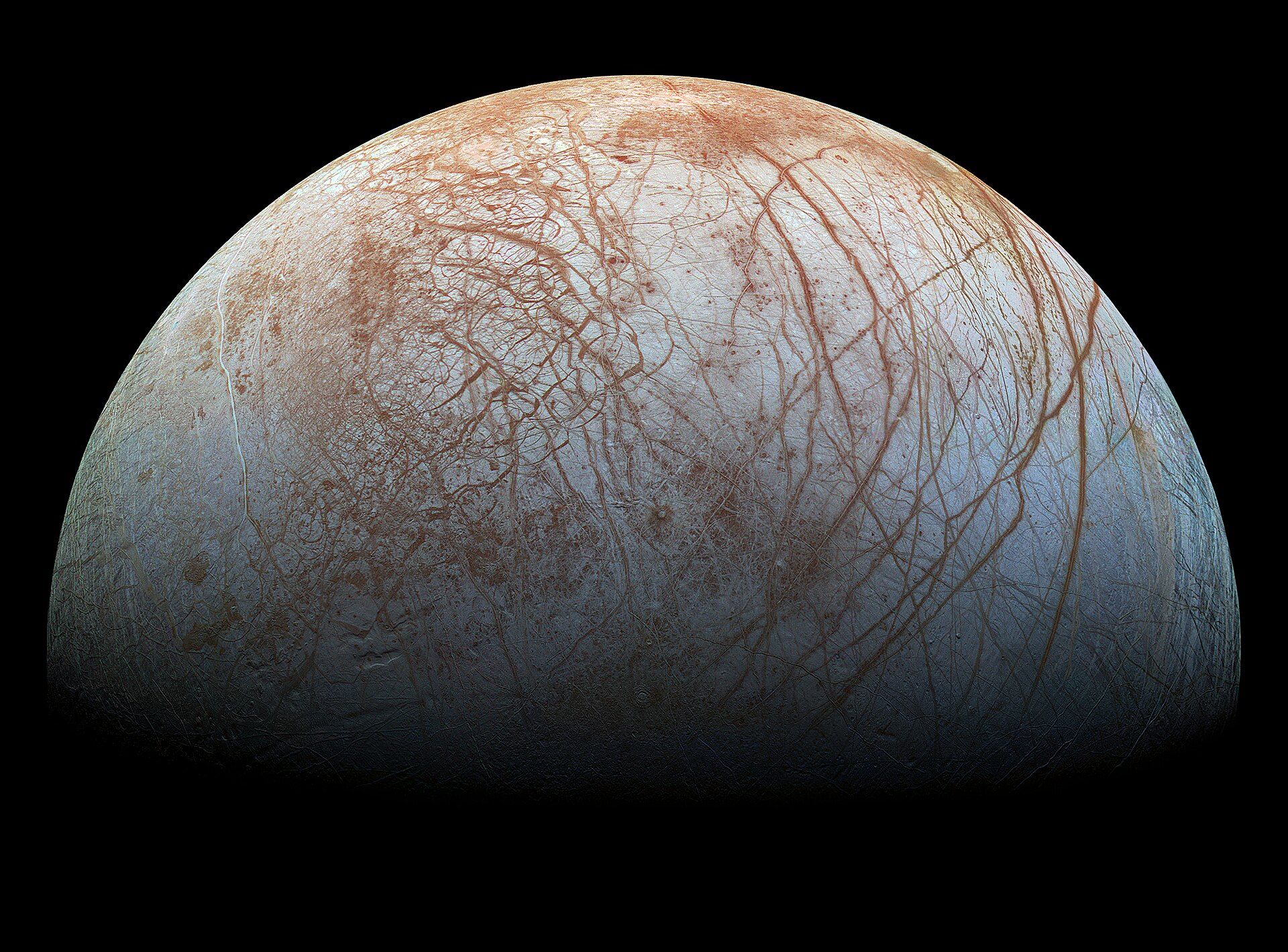
Deciding whether Europa’s hidden ocean could support life requires more than orbital snapshots. It requires measuring the thickness of the ice, mapping the ocean beneath it, sampling whatever escapes to the surface, and doing all of it in one of the harshest radiation environments in the solar system.
That is the job of Europa Clipper, the largest planetary spacecraft NASA has built.
Orbiting Jupiter, not Europa
The mission’s central design decision looks counterintuitive at first: the spacecraft will not orbit Europa. It will orbit Jupiter on a long, looping path, dipping past Europa for close flybys and then retreating.
The reason is radiation. Jupiter’s magnetosphere accelerates charged particles to enormous energies, and Europa sits inside the worst of it. A spacecraft parked in Europa orbit would accumulate a lethal dose to its electronics in a matter of weeks. By spending most of each orbit far from Jupiter and only sprinting through the danger zone, Clipper can accumulate dozens of close passes over years rather than dying after a few.
Even so, the most sensitive electronics are housed in a thick-walled vault of titanium and aluminium — essentially a radiation-shielded safe at the heart of the spacecraft.
What it carries
The instrument suite is built to answer three questions: how thick is the ice, what is the ocean like, and what is the surface made of.
- An ice-penetrating radar designed to profile the shell and look for water pockets within it, or the boundary at its base.
- A magnetometer to refine the induced-field measurements that first indicated a conductive ocean, tightening the constraints on its depth and salinity.
- Mass spectrometers to sample gas and dust around the moon, including any material lofted from plumes or knocked off the surface by micrometeorites.
- Cameras and spectrometers covering visible, ultraviolet, and infrared wavelengths to map composition and geology at high resolution.
- A thermal imager to hunt for warm spots that might mark recent activity or thin ice.
Notably, several of these instruments can sample Europa’s material without landing. If plumes vent from the subsurface, flying through one turns a flyby into a sampling mission.
The spacecraft’s solar arrays span more than thirty metres — necessary because sunlight at Jupiter is roughly one twenty-fifth as strong as at Earth.
Getting there
Jupiter is a long way, and a direct transfer is expensive in fuel. Clipper takes an indirect route, using gravity assists to build up speed over several years before arrival. Once in the Jovian system, the orbit is gradually reshaped by repeated encounters, bringing the spacecraft over different parts of Europa on each pass so the coverage accumulates into a global map.
The plan calls for roughly fifty close flybys, some passing within a few tens of kilometres of the surface.
Not travelling alone
Europa Clipper shares the Jupiter system with the European Space Agency’s JUICE mission, which launched earlier and is focused primarily on Ganymede, with flybys of Callisto and Europa along the way. Ganymede is the only moon known to generate its own internal magnetic field, and it is thought to hold a deep ocean of its own.
Two spacecraft studying the same system with complementary instruments is a substantial upgrade over anything since Galileo, the orbiter that first made the case for Europa’s ocean in the 1990s.
What it will not do
It is worth being precise about the mission’s limits. Europa Clipper is not a life-detection mission. It carries no instrument capable of confirming biology, and it will not land, drill, or reach the ocean.
Its purpose is habitability assessment: determining whether the environment has the ingredients life requires. That distinction matters, because the results will shape what gets built next. If the ice turns out to be thin in places, or plumes are confirmed as a reliable sampling route, the case for a lander becomes far stronger — and far better targeted.
The reconnaissance has to come first.