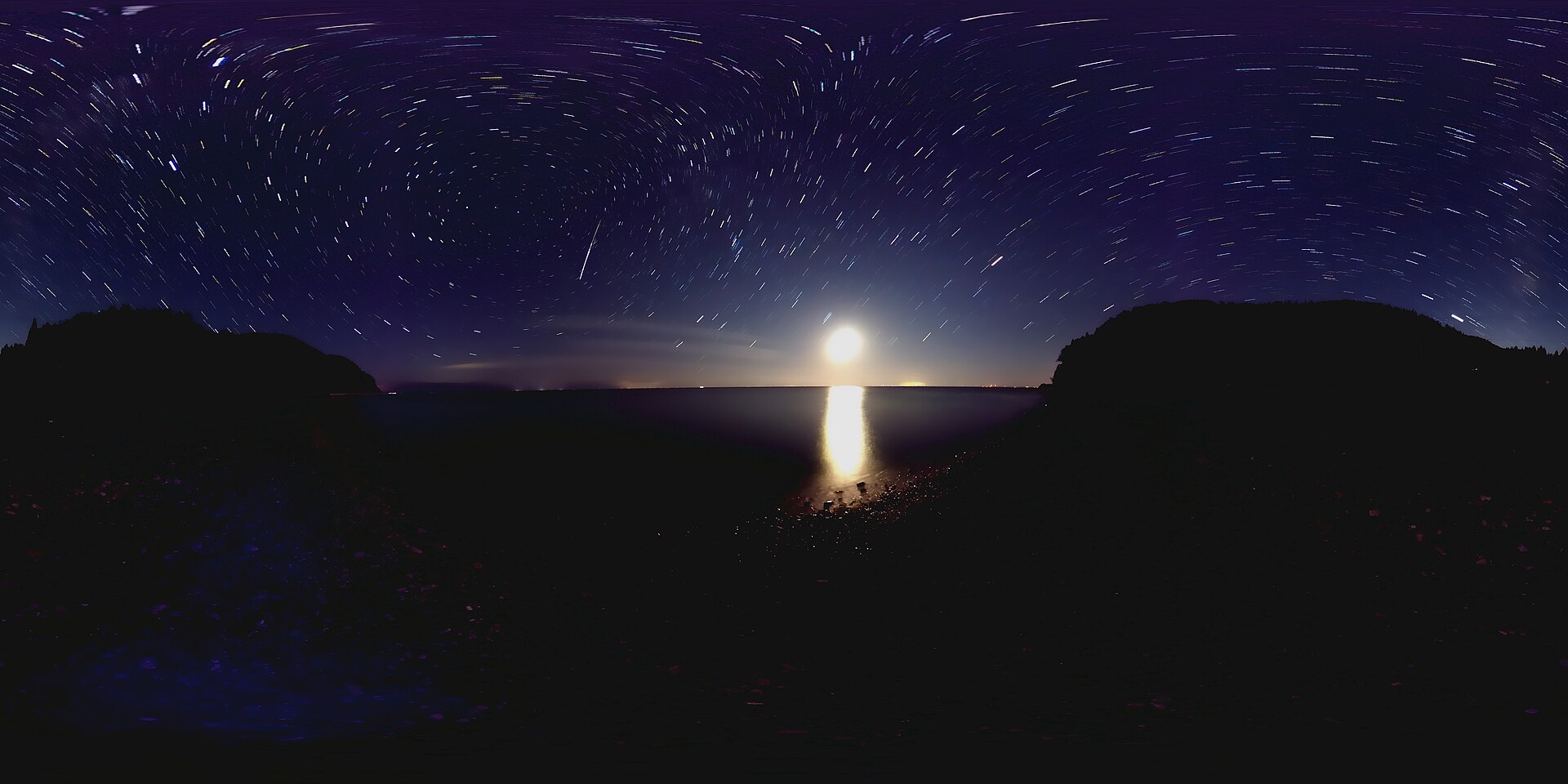
Meteor showers are the most democratic event in astronomy. No telescope, no app, no expensive optics, no technical skill. The main requirements are a dark spot, a clear sky, and the willingness to be outside at an inconvenient hour.
Here is how to get the most out of one.
What you are actually watching
A meteor shower happens when Earth ploughs through a trail of debris left behind by a comet — or, in a couple of cases, an asteroid. The particles are mostly tiny, often no bigger than a grain of sand. They hit the atmosphere at tens of kilometres per second, compress the air in front of them, and vaporise in a streak of glowing gas roughly eighty to a hundred kilometres up.
Nothing is falling on you. The “shooting star” is a very small object being destroyed very fast, very high.
Because the debris stream is travelling in a specific direction, all the meteors in a shower appear to radiate from one point in the sky, called the radiant. That is a perspective effect, the same reason parallel railway tracks seem to converge. Showers are named for the constellation the radiant sits in — Perseids from Perseus, Geminids from Gemini.
The showers worth planning around
A handful of showers reliably deliver.
- The Perseids peak in mid-August, with warm northern-hemisphere nights and fast, bright meteors. Debris comes from Comet Swift-Tuttle.
- The Geminids peak in mid-December and are often the richest shower of the year, producing slower, sometimes yellowish meteors. Their parent is the odd rocky object 3200 Phaethon.
- The Quadrantids in early January can be intense but have a very sharp peak, often only a few hours wide.
- The Orionids in October and the Lyrids in April are more modest but still worth an evening.
Timing matters more than anything
Two factors dominate whether you see a good show or a disappointing one, and both are predictable well in advance.
The first is the Moon. A bright Moon washes out faint meteors just as effectively as a streetlight. A shower peaking near new Moon is worth travelling for; the same shower peaking near full Moon may be barely noticeable. Check the phase before committing.
The second is the hour. Rates almost always improve after local midnight and are usually best in the hours before dawn. The reason is geometry: after midnight you are on the leading side of Earth as it moves along its orbit, sweeping into the debris head-on. Before midnight, meteors have to catch up from behind.
The pre-dawn hours are not a hardcore observer’s affectation. They genuinely produce several times more meteors.
Where to stand, and how to look
Get away from direct light. You do not necessarily need a certified dark-sky site — a rural field, a park away from streetlamps, or even a garden with the house between you and the nearest floodlight will noticeably help.
Then let your eyes adapt. Full dark adaptation takes twenty to thirty minutes and is undone in seconds by a phone screen. If you need light, use a red torch or a phone in red-shift mode at minimum brightness.
Do not look at the radiant. Meteors near the radiant appear foreshortened as short stubs; those forty to sixty degrees away from it show much longer trails. Look at a broad patch of sky roughly halfway up, in a direction with the fewest obstructions.
Lie down. A reclining chair, a sleeping bag, or a picnic blanket lets you take in a wide field of sky without craning your neck for an hour.
Managing expectations
Published rates are given as a zenithal hourly rate, which is the number a perfect observer would see under perfect conditions with the radiant directly overhead. Real numbers under a real sky are lower, often by half or more. A “hundred per hour” shower might realistically deliver twenty to forty from a decent dark site.
That is still roughly one every couple of minutes, which is plenty. Dress warmer than you think you need to, bring something hot to drink, and give it at least an hour — meteors arrive in clumps, and quitting after fifteen quiet minutes is the most common mistake.