Tag: Origins

  • The Big Bang: What We Know About the Universe’s First Moments

    The Big Bang: What We Know About the Universe’s First Moments

    The Big Bang is routinely misdescribed, including by people who should know better. It was not an explosion in space. There was no centre, no bang, and nothing sitting in a void waiting to detonate.

    What the theory actually says is more modest and better supported: the universe was once hot, dense, and nearly uniform, and it has been expanding and cooling ever since. Everything else follows from that.

    The evidence

    Three independent observations underpin the model, and they were not designed to fit together.

    Everything is receding

    Distant galaxies show redshifted light, and the redshift increases with distance. Run that expansion backwards and the material of the universe converges toward arbitrarily high density at a finite time in the past — currently placed at about 13.8 billion years ago.

    The universe is glowing faintly at microwave wavelengths

    For its first few hundred thousand years, the universe was an opaque plasma. Photons scattered constantly off free electrons and could not travel far. As expansion cooled the plasma below roughly 3,000 kelvin, electrons and nuclei combined into neutral atoms, and the universe abruptly became transparent.

    The light released at that moment has been travelling ever since, stretched by expansion into the microwave band. It arrives from every direction at a temperature of about 2.7 kelvin. This cosmic microwave background was predicted before it was found, and its discovery in 1965 effectively settled the argument between the Big Bang model and its steady-state rival.

    The lightest elements are in the right proportions

    In the first few minutes, the universe was hot enough for nuclear fusion but expanding too fast for it to continue long. The model predicts specific abundances of hydrogen, helium, and traces of lithium and deuterium emerging from that brief window.

    The predicted values — roughly seventy-five percent hydrogen and twenty-five percent helium by mass — match what is measured in the oldest, least processed material astronomers can find. That agreement spans several elements across many orders of magnitude in abundance, from a calculation with essentially one free parameter.

    A theory that predicts the temperature of the sky and the chemical composition of the universe from the same set of equations is doing real work.

    The timeline

    The sequence, compressed:

    • In the first fraction of a second, the universe is thought to have undergone inflation — an episode of extraordinarily rapid expansion that flattened its geometry and stretched quantum fluctuations into the seeds of all later structure.
    • Within the first second, the fundamental forces took their present distinct forms and quarks condensed into protons and neutrons.
    • Over the first few minutes, nuclear fusion produced the light elements.
    • For 380,000 years, the universe remained an opaque plasma.
    • At 380,000 years, atoms formed and the microwave background was released.
    • A long dark period followed, during which gravity slowly amplified the small density variations left over from inflation.
    • Somewhere in the first few hundred million years, the first stars ignited, and galaxies began assembling.

    The parts we cannot see

    Note where the account starts. The model describes the universe from a tiny fraction of a second onward, not from a moment of creation.

    Earlier than that, densities and temperatures exceed anything current physics can describe. General relativity predicts a singularity, but that prediction is generally taken as the theory announcing its own breakdown rather than a statement about reality. Describing the first instant requires a theory unifying quantum mechanics and gravity, which does not yet exist.

    So “what came before the Big Bang” is not a question the theory refuses to answer out of stubbornness. It is a question that requires physics we do not have.

    What inflation explains, and what it does not

    Inflation was proposed to solve specific puzzles. Why is the universe geometrically flat to high precision? Why do regions on opposite sides of the sky, which have never been in causal contact, have almost exactly the same temperature? Why do we not observe the exotic relics that some particle theories predict?

    Rapid early expansion answers all three: it flattens curvature, it means the whole observable universe was once a tiny causally connected patch, and it dilutes any relics to undetectable levels.

    Inflation also makes a prediction that has been tested — that quantum fluctuations stretched to cosmic scales should leave a specific statistical pattern in the microwave background. The observed pattern matches well.

    What remains unsettled is the mechanism. Inflation is a framework rather than a single theory, with many possible implementations and no consensus on which is right, and no direct evidence yet for the primordial gravitational waves that many versions predict.

    Where it stands

    The hot Big Bang model is among the best-tested theories in science, describing the universe’s history from the first second to the present with quantitative precision.

    It is also unmistakably incomplete. It requires dark matter and dark energy, neither of which is understood. It cannot describe its own initial conditions. And there is a live disagreement about the current expansion rate that has resisted a decade of scrutiny.

    That combination — enormously successful and visibly unfinished — is roughly where a healthy scientific field should be.
  • Comets and Asteroids: The Solar System’s Time Capsules

    Comets and Asteroids: The Solar System’s Time Capsules

    The planets are the solar system’s finished products, reprocessed by heat, pressure, and four and a half billion years of geology. Comets and asteroids are the offcuts — leftover material that never assembled into anything larger, and which in many cases has barely changed since.

    That makes them the closest thing available to a physical record of what the solar system was made of before the planets rearranged everything.

    The basic distinction

    The traditional split is compositional and reflects where each population formed.

    Asteroids are rocky and metallic, and formed inside the frost line — the distance from the young Sun beyond which water ice could remain solid. Most orbit in the main belt between Mars and Jupiter.

    Comets are ice-rich mixtures of water ice, frozen carbon dioxide, carbon monoxide, ammonia, methane, dust, and organic compounds. They formed further out where those ices were stable, and they reside in two distant reservoirs: the Kuiper Belt beyond Neptune, and the Oort Cloud, a roughly spherical shell extending an appreciable fraction of the way to the nearest stars.

    The line has blurred with better observation. Some asteroids show comet-like activity; some comets appear largely depleted of volatiles. The populations grade into each other.

    Why comets grow tails

    A comet spends most of its orbit as an inert nucleus, typically a few kilometres across and among the darkest material in the solar system.

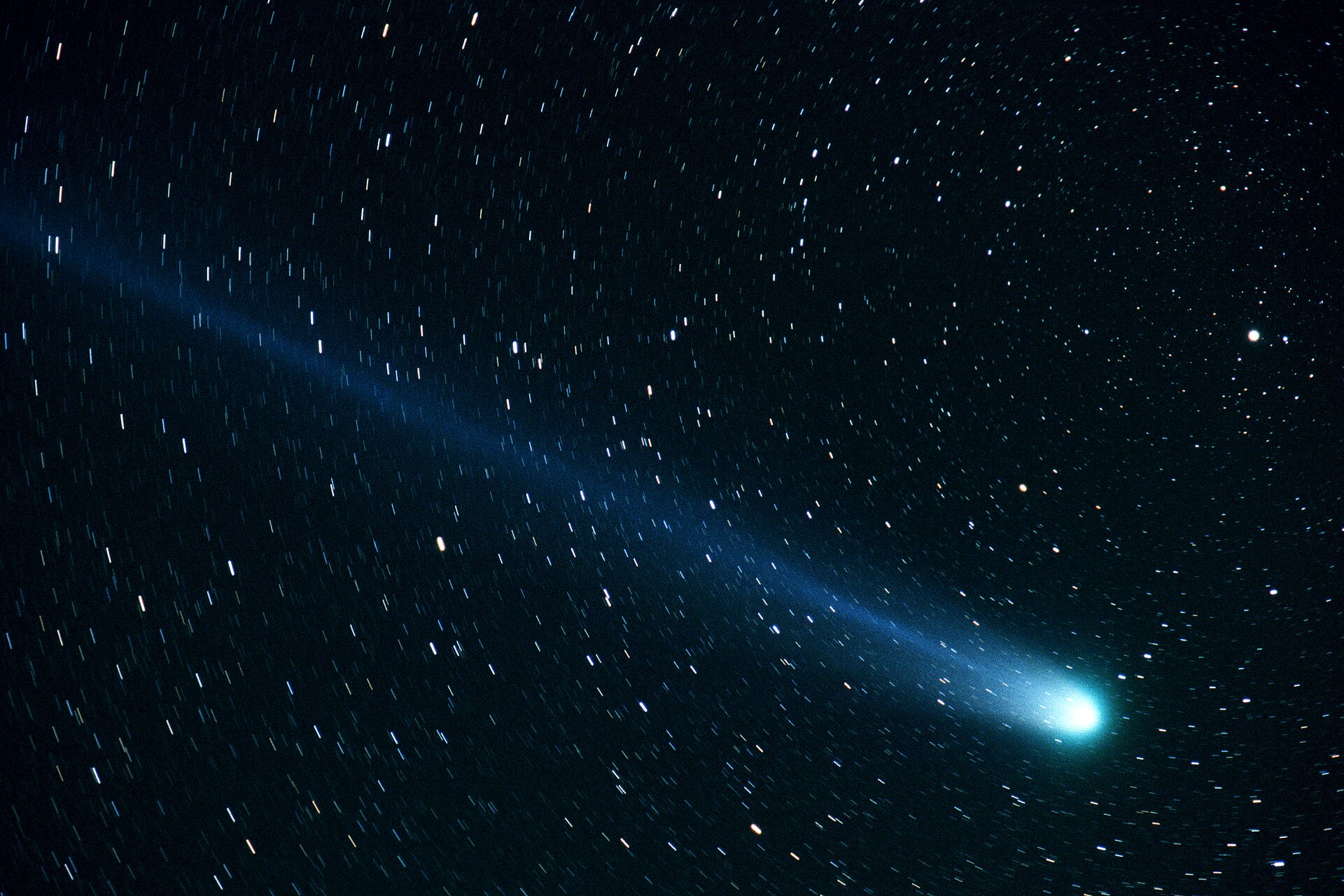
    Approaching the Sun, its surface ices sublimate directly from solid to gas. The escaping gas carries dust with it, forming a coma — a diffuse atmosphere that can swell to hundreds of thousands of kilometres across, far larger than the nucleus itself.

    Two distinct tails then develop, and they point in different directions.

    • The dust tail is pushed outward by radiation pressure. Because the released dust retains some of the comet’s orbital motion, this tail is broad and curved, often appearing yellowish-white from reflected sunlight.
    • The ion tail is formed of gas ionised by solar ultraviolet and swept directly away by the solar wind. It points almost exactly anti-sunward regardless of the comet’s direction of travel, and glows blue from carbon monoxide ions.

    A comet’s tail therefore does not trail behind it. On the outbound leg of the orbit, the comet is chasing its own tail.

    The nucleus of a comet is typically darker than charcoal. Everything spectacular about a comet is material it is losing.

    Why the main belt never became a planet

    The asteroid belt is often described as a shattered planet. It is not. The total mass of everything in it is only a small fraction of the Moon’s.

    The belt failed to accrete because Jupiter formed nearby and early. Its gravity stirred the region, raising relative velocities to the point where collisions between planetesimals became destructive rather than constructive. Bodies that met at a few metres per second stick together; bodies that meet at five kilometres per second shatter.

    Orbital resonances with Jupiter also carved gaps in the belt — the Kirkwood gaps — where repeated gravitational nudges destabilise orbits over time. It is partly through those resonances that fragments get delivered to the inner solar system as meteorites.

    What they have told us

    Meteorites — asteroid fragments that survive to the ground — are the oldest solids anyone has ever handled. Radiometric dating of inclusions within primitive meteorites gives an age of about 4.567 billion years, and that measurement is the basis for the accepted age of the solar system.

    Comets have been visited by spacecraft, including one mission that orbited a comet for two years and watched its activity rise and fall through perihelion. Sample return missions have brought material back from asteroids, and analysis has found amino acids, sugars, nucleobases, and a range of organic compounds.

    That last point connects to a long-running question about Earth’s origins. The young Earth was hot enough that much of its volatile inventory should have been lost, yet it has oceans and an organic-rich surface chemistry. Delivery by impacting comets and asteroids is a leading explanation, and the isotopic composition of water in some asteroids matches Earth’s ocean water reasonably well — better, in fact, than most comets measured so far.

    The practical dimension

    Some of these objects cross Earth’s orbit, and the historical record of impacts is unambiguous.

    Surveys now track near-Earth objects systematically, and the large ones — the size that would cause global effects — are largely catalogued, with no known impact threat in the foreseeable future. Smaller objects, in the range capable of destroying a city, are far more numerous and much less completely inventoried.

    A deflection test has been carried out, deliberately impacting a small asteroid moon to measure the change in its orbit. The result demonstrated that a kinetic impactor can meaningfully alter an asteroid’s trajectory — the first practical demonstration that this particular natural hazard is one that can, in principle, be prevented.