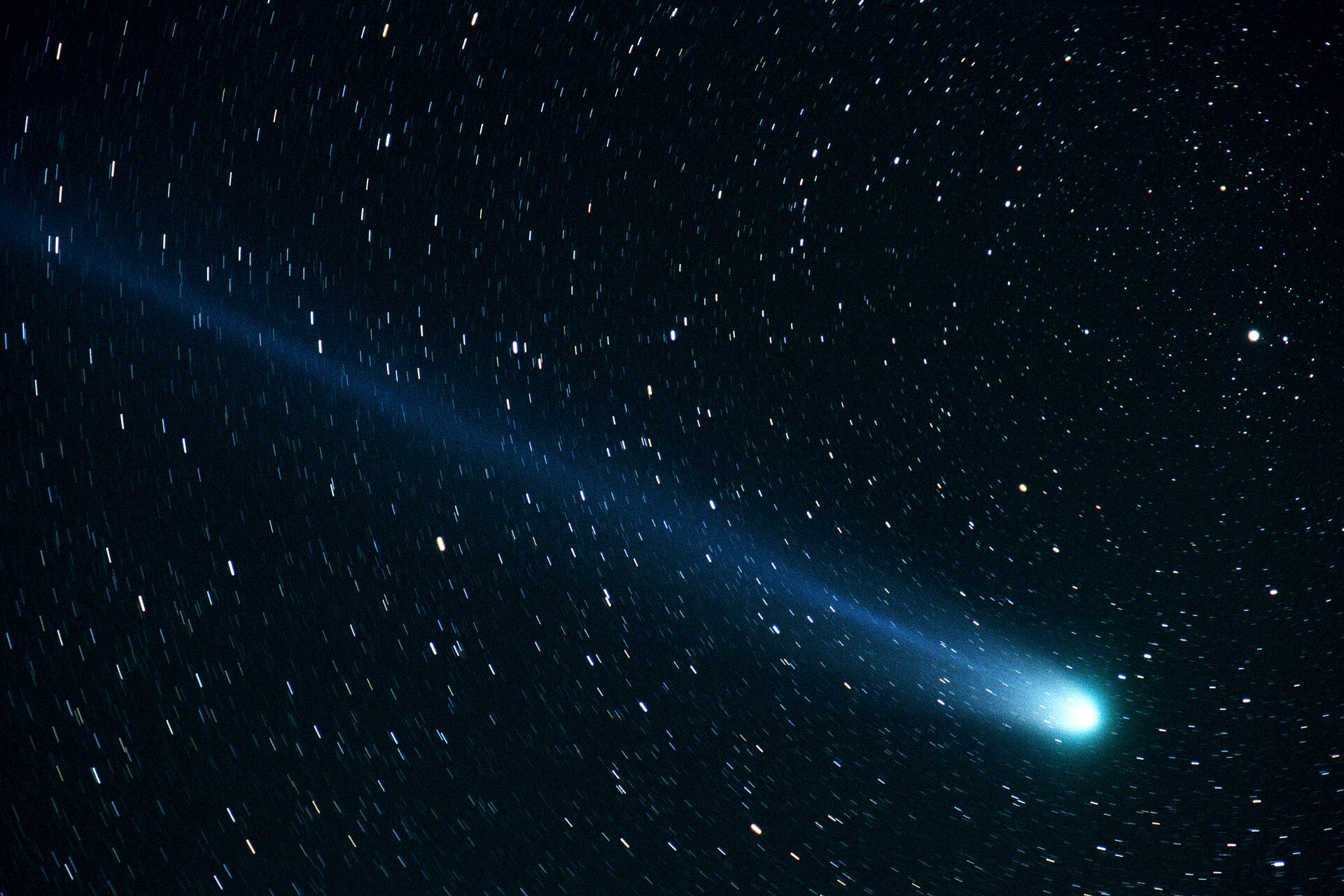
The planets are the solar system’s finished products, reprocessed by heat, pressure, and four and a half billion years of geology. Comets and asteroids are the offcuts — leftover material that never assembled into anything larger, and which in many cases has barely changed since.
That makes them the closest thing available to a physical record of what the solar system was made of before the planets rearranged everything.
The basic distinction
The traditional split is compositional and reflects where each population formed.
Asteroids are rocky and metallic, and formed inside the frost line — the distance from the young Sun beyond which water ice could remain solid. Most orbit in the main belt between Mars and Jupiter.
Comets are ice-rich mixtures of water ice, frozen carbon dioxide, carbon monoxide, ammonia, methane, dust, and organic compounds. They formed further out where those ices were stable, and they reside in two distant reservoirs: the Kuiper Belt beyond Neptune, and the Oort Cloud, a roughly spherical shell extending an appreciable fraction of the way to the nearest stars.
The line has blurred with better observation. Some asteroids show comet-like activity; some comets appear largely depleted of volatiles. The populations grade into each other.
Why comets grow tails
A comet spends most of its orbit as an inert nucleus, typically a few kilometres across and among the darkest material in the solar system.
Approaching the Sun, its surface ices sublimate directly from solid to gas. The escaping gas carries dust with it, forming a coma — a diffuse atmosphere that can swell to hundreds of thousands of kilometres across, far larger than the nucleus itself.
Two distinct tails then develop, and they point in different directions.
- The dust tail is pushed outward by radiation pressure. Because the released dust retains some of the comet’s orbital motion, this tail is broad and curved, often appearing yellowish-white from reflected sunlight.
- The ion tail is formed of gas ionised by solar ultraviolet and swept directly away by the solar wind. It points almost exactly anti-sunward regardless of the comet’s direction of travel, and glows blue from carbon monoxide ions.
A comet’s tail therefore does not trail behind it. On the outbound leg of the orbit, the comet is chasing its own tail.
The nucleus of a comet is typically darker than charcoal. Everything spectacular about a comet is material it is losing.
Why the main belt never became a planet
The asteroid belt is often described as a shattered planet. It is not. The total mass of everything in it is only a small fraction of the Moon’s.
The belt failed to accrete because Jupiter formed nearby and early. Its gravity stirred the region, raising relative velocities to the point where collisions between planetesimals became destructive rather than constructive. Bodies that met at a few metres per second stick together; bodies that meet at five kilometres per second shatter.
Orbital resonances with Jupiter also carved gaps in the belt — the Kirkwood gaps — where repeated gravitational nudges destabilise orbits over time. It is partly through those resonances that fragments get delivered to the inner solar system as meteorites.
What they have told us
Meteorites — asteroid fragments that survive to the ground — are the oldest solids anyone has ever handled. Radiometric dating of inclusions within primitive meteorites gives an age of about 4.567 billion years, and that measurement is the basis for the accepted age of the solar system.
Comets have been visited by spacecraft, including one mission that orbited a comet for two years and watched its activity rise and fall through perihelion. Sample return missions have brought material back from asteroids, and analysis has found amino acids, sugars, nucleobases, and a range of organic compounds.
That last point connects to a long-running question about Earth’s origins. The young Earth was hot enough that much of its volatile inventory should have been lost, yet it has oceans and an organic-rich surface chemistry. Delivery by impacting comets and asteroids is a leading explanation, and the isotopic composition of water in some asteroids matches Earth’s ocean water reasonably well — better, in fact, than most comets measured so far.
The practical dimension
Some of these objects cross Earth’s orbit, and the historical record of impacts is unambiguous.
Surveys now track near-Earth objects systematically, and the large ones — the size that would cause global effects — are largely catalogued, with no known impact threat in the foreseeable future. Smaller objects, in the range capable of destroying a city, are far more numerous and much less completely inventoried.
A deflection test has been carried out, deliberately impacting a small asteroid moon to measure the change in its orbit. The result demonstrated that a kinetic impactor can meaningfully alter an asteroid’s trajectory — the first practical demonstration that this particular natural hazard is one that can, in principle, be prevented.